

TEACHING GUIDE 8
The Queen of Hearts,
She made some tarts
All on a summer’s day.
The Knave of Hearts,
He stole those tarts
And took them clean away.
The King of Hearts,
He called for the tarts
And caught the knave for sure.
The Knave of Hearts,
Brought back the tarts
And vowed he’d steal no more.
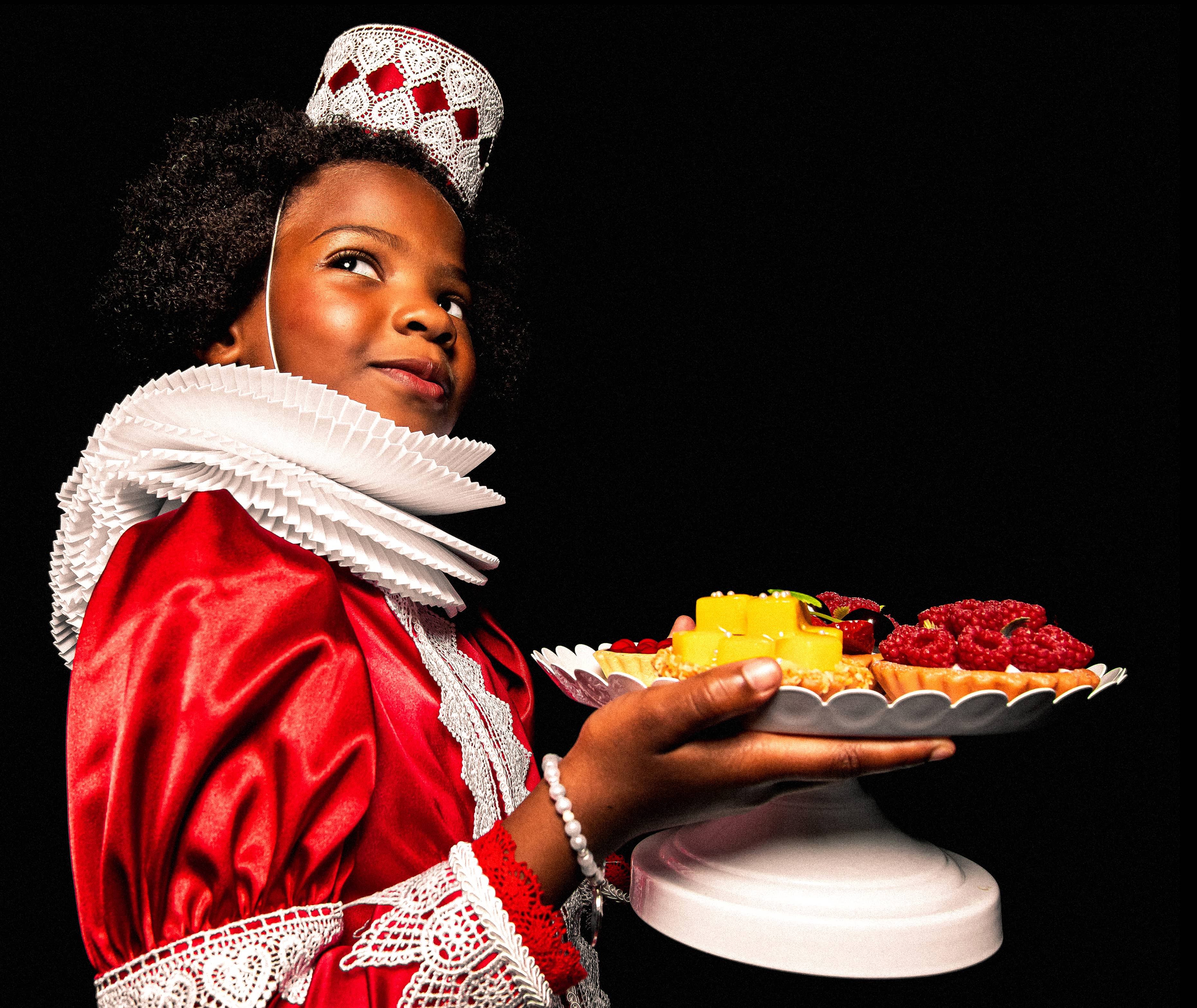
Photograph by Joe Mazza / Brave Lux
The Queen of Hearts: Introduction
The Queen of Hearts
“The Queen of Hearts” is a rhyme with a story to tell. There are three distinct characters and a well-defined plot line in this simple rhyme. The tarts are made by the Queen, stolen by the Knave, called for by the King, and returned by the Knave, who takes an oath to never steal again. Mother Goose has written a tidy parable: the Knave commits a crime and is caught, he admits his guilt and is forgiven. This rhyme will inspire a lively discussion about thievery, fairness, remorse and redemption.
A Rhyme with a Story to Tell
This rhyme provides a perfect little script for a pantomime. With very simple props, children can take on the roles of the three characters and play out the drama in front of their classmates. Have the children notice how the Knave places his hand over his heart while taking his vow in the music video.
A Change of Heart
The word “knave” will most likely be new to young children. A knave is a “rascal”, a villain, a person who steals and lies. But the Knave has a change of heart and brings back what he has stolen. He makes an earnest promise; he “vows” to steal no more. Children will see in the music video that the Knave’s promise is accepted, all is forgiven, and everyone dances together in the end.
Red and White
There are white hearts in the lace of the Queen’s costume and the Knave wears a large red satin heart in the center of his tunic. Your children can clearly identify and study these colors in the photographs and music video. Ask them to list other objects that are red (blood, lips, roses, cardinals, cherries, apples, strawberries, raspberries, tomatoes, beets, ladybugs, lobsters, fire trucks, fire hydrants, poppies, peppers, stop signs, and stop lights). Then make a list of things that are white (teeth, snow, clouds, swans, polar bears, milk, coconut, rice).
What is a Tart?
The word “tart” might be new to some young children (a filled “pastry” with only a bottom crust). Trays of tarts can be seen in the photographs and videos of this rhyme. Ask your children to list other types of pastries and desserts (cakes, cookies, pies, donuts, muffins, cupcakes, puff pastries, sweet buns, baklava, churros). Have they ever baked? Did they follow a recipe? What ingredients did they use (flour, sugar, butter, cream)? Your class could bake together, or be encouraged to bake at home.
The Hardest Working Muscle
Everyone has a heart, it’s a very important part of your body. It’s the hardest working muscle/organ inside you. It never stops pumping. The heart pushes your blood to all the places inside you. You can feel it pulsing in the artery of your wrist (60-100 beats per minute). If you put your ear to someone’s chest, you can hear their heart beating.
A Heart of Gold
But the heart is also a powerful symbol full of meaning. It represents life and love, courage, joy, compassion, and human connection. The heart is seen as the center of human emotion, the place inside us where the soul is found. We express love from “the bottom of our hearts” and if someone has no sympathy, we call them “heartless.”
The English language is rich with idiomatic expressions concerning the heart. Here are a few examples: “change of heart,” “cross my heart,” “from the bottom of my heart,” “wear your heart on your sleeve,” “heart of gold,” “heart of stone,” “big-hearted,” “soft-hearted,” “in a heartbeat,” and “at the heart of it.” When your motives are pure, “your heart is in the right place.” When you are true to yourself, you “follow your heart.” When you feel a deep sadness, you are “broken-hearted.” Talk with your children about this incredibly nuanced word.
Paper Hearts and Garlands
We’ve placed this rhyme in February to connect it to Valentine’s Day. The “Queen of Hearts” music video opens with Mother Goose dancing under a garland of hearts. Make folded paper hearts with your children, string them together. Create valentines to exchange with classmates or to take home. Celebrate Valentine’s with a party and serve cherry tarts!
The Queen of Hearts: Discussion
The Stealing of Tarts
Who baked the tarts? Who stole them? Why do you think the Knave stole the tarts? How do you think the Queen felt after she made her beautiful tarts for her family and they were stolen?
Forgiveness
Did the King and Queen forgive the Knave for stealing their tarts? Would you forgive someone who stole your tarts? How does it feel to forgive someone? How does it feel to be forgiven?
New Words
What is a “tart”? What is a “knave”? What is a “vow”?
The Color Red
Can you name some things that are red? Examples: apples, cherries, strawberries, raspberries, ladybugs, lobsters, poppies, peppers, fire trucks, fire hydrants, roses, beets, blood, lips, cardinals, tomatoes, stop signs, and stop lights.
The Color White
Can you name some things that are white? Examples: teeth, milk, snow, paper, pearls, bones, eggs, clouds, cotton, swans, rice, the moon, snowy owl, lily of the valley, daisies, polar bears, coconut, cauliflower, garlic.
Tarts and Other Pastries
Tarts are a type of pastry, can you name some others? Examples: cakes, cookies, pies, donuts, muffins, cupcakes, puff pastries, sweet buns, baklava, churros. Which pastry is your favorite?
In a Heartbeat
The heart is the muscle that pumps blood to all the places inside you. It is always beating. Let’s see if we can feel the pulse of our hearts in our wrists. When we exercise, our hearts pump faster. This makes our hearts stronger. If you do something quickly, you do it “in a heartbeat.”
Cross My Heart
We use the word “heart” in lots of ways to talk about our feelings. What does it mean to have “a change of heart”? What is the difference between a person with a “heart of gold” and a person with a “heart of stone”? We call a person who is kind “soft-hearted” but a person who is cruel is “hard-hearted.” When you make a promise, you say “I cross my heart.” When you feel something deeply, you feel it “from the bottom of your heart.” When you feel a deep sadness, you are “brokenhearted.”
The Queen of Hearts: Language
KEY RHYMING WORDS
hearts – tarts
RESPONSE RHYMING WORDS:
smart – start – dart – cart – part – chart
VOCABULARY
“tart”
“knave”
“vow”
“rascal”
“forgiveness”
“pastry”
IDIOMS
“a change of heart”
“cross my heart”
“from the bottom of my heart”
“heart of gold”
“heart of stone”
“big-hearted”
“soft-hearted”
“broken-hearted”
“your heart is in the right place”
“wear your heart on your sleeve”
“take it to heart”
“follow your heart”
“pour out your heart”
“in a heartbeat”
“at the heart of it”
The Queen of Hearts: Activities
OVERVIEW
In the following activities, children will act out the drama of the tarts and make paper heart garlands to decorate their classroom for Valentine’s Day. They will learn about “tempo” (how fast or slow a piece of music is) and experiment with that element of music. They will create their own costume pieces for dramatic play and a celebration.
1. ACTIVITY: Queen of Hearts Pantomime
Children can choose roles to play and take turns doing a pantomime of the rhyme. Be sure to have a fun set of props (tray and tarts) and costume pieces (crowns, caps, capes, etc.).
2. CRAFT: Paper Hearts
If you are learning this rhyme unit during the month of February, celebrate Valentine’s Day with folded cut-out paper hearts and paper heart garlands. Make them with your children and decorate your room!
3. GAME: Tempo
Teacher: “We’re going to play a game called ‘Tempo’. In this game, we are going to move our bodies to the ‘tempo’ of the music. ‘Tempo’ is how fast or slow the music is played and sounds to our ears.”
You can learn more about tempo in the MUSIC section of this teaching guide.
Children standing with space to move.
1. Play the Queen of Hearts song.
2. Everyone dances to the tempo of the song.
3. Each child takes a turn leading the group with one movement on tempo.
Examples:
jumping
waving
turning
wiggling
swaying
4. CRAFT: The Queen of Hearts Party
Materials:
paper doilies, tissue boxes, paper plates, anything recyclable for the base of a hat
headbands, yarn, ribbon, pom-poms, hearts, stickers, glitter, flowers, fruit, etc.
scissors, hot glue gun, tape, staples, etc.
Teacher: “We’re all invited to The Queen of Hearts Party, let’s make some special hats for the occasion!”
1. Begin by showing the ” Queen of Hearts” video. Pause occasionally to study the crowns, hats, other costumes, and the tarts.
2. Guide children to pick a base for their hat.
3. Ask them to decorate their hat however they would like.
4. Attach the base to a headband with ribbons, or yarn to tie under the chin.
5. Take a picture of all the children ready for the Queen of Hearts party!
6. Play the Queen of Hearts video and dance!
5. GAME: On the Spot!
Materials:
mark a special space on the floor in the middle of your circle (a heart shaped out of red tape?)
heart/tart hats
Teacher: “Now, we are going to have a dance party! Let’s put on our party hats and make a big circle around this spot (heart) on the floor. I’ll play the song and we’ll all clap in time with the tempo. When I call your name and say ‘________________ on the spot,’ you jump in the middle and lead us in a dance. We’ll follow all your motions until I call another name.”
Standing in a circle.
1. Mark a special spot on the floor.
2. Invite your children to make a large circle around it.
3. Play the “Queen of Hearts” song.
4. Everyone claps in time with the music, marking the tempo.
5. Teacher: call out the name of one child with, “___________ on the spot!”
6. This child becomes the leader and dances in the center, everyone follows their motions.
7. Teacher: calls out another child to take their place and the game continues until everyone has had a turn to lead.
Seated as an audience in front of a stage.
1. Invite everyone to put on their hat for The Queen of Hearts Party!
2. The audience keeps tempo (fast or slow).
3. Actors change who is the leader on stage.
The Queen of Hearts: Music
THE MUSIC
How does this music make you feel?
Is this music slow or fast?
Does it change your mood?
What pictures does this music create in your mind?
Do you imagine a particular place, person, thing, color, animal, etc.?
How would you move to this music?
THE INSTRUMENTS
What instruments do you hear, can you name them?
How do you think the instruments make their sounds?
Are they blown through, plucked, strummed, bowed, tapped, hit, or struck?
Are these instruments made of wood or metal?
Trumpet
The trumpet is a brass instrument commonly used in classical and jazz ensembles. Sound is produced by vibrating the lips in a mouthpiece. The trumpet makes the highest sounds in the brass instrument family.
Trombone
The trombone is a brass instrument commonly used in classical and jazz ensembles. Sound is produced by vibrating the lips in a mouthpiece. The trombone typically does not have any buttons or valves and uses a slide to change pitches.
Saxophone
The saxophone is a woodwind instrument that is most often used in concert bands and jazz ensembles. To make sound saxophones, have a single reed on the mouthpiece that vibrates. There are three common types of saxophones that vary in size: alto, tenor, and baritone. In “The Queen of Hearts” music video, you will see a tenor saxophone.
Piano
The piano is a large wooden instrument that produces sound with a system of keys that move small hammers to strike tightly wound metal strings. It is considered part of both the percussion and the string families. The body of the piano is essentially a large wooden box on legs with a flat metal soundboard inside. The thicker (lower) pitched strings are strung on the left side of the soundboard and the thinner (higher) pitched strings on the right. Most pianos have 88 keys: 52 white and 36 black. Upright pianos are smaller than grand pianos but have the same number of keys. All pianos have a lid that can be opened or closed to change the volume.
Guitar
The guitar is a stringed instrument that typically has six strings and is played by strumming or plucking with one hand while using the fingers of the other to press the strings in various combinations to make chords.
Electric Bass
Similar to the guitar, it is a stringed instrument that is strummed or plucked to make sound. However, the bass guitar typically has a longer neck and only four strings.
Drum Set
A collection of drums and cymbals are set up to be played by one person. The drummer uses drumsticks in their hands and operates a pair of cymbals and the bass drum with their feet.
GENRE: Soul-Pop
“Queen of Hearts” combines elements of soul, R&B, and pop music. Soul-pop is recognized by upbeat and catchy melodies, often incorporating elements of funk, hip-hop, and jazz.
LESSON 1: What is Tempo?
“Tempo” is how fast or slow the music is played and sounds to our ears. You will find a game that explores tempo in the ACTIVITIES page.
Counting Out the Beats
Music can be broken down into individual beats that are counted in a repeating pattern. “The Queen of Hearts” would be counted in increments of four. Have your children count as they clap (1, 2, 3, 4) and give each beat equal emphasis. It might be helpful to turn off the music and sing/clap unaccompanied.
Feeling the Pulse
In the song “The Queen of Hearts,” there are accents on the second and fourth beats. This time, have your children count as they clap, but give emphasis to the second and fourth beats (1, 2, 3, 4). Try playing the pattern with a combination of lap slaps and claps. Maybe pair up and turn this exercise into a clapping game.
LESSON 2: What is a Solo?
A “solo,” in music is when other musicians in an ensemble make room for one instrument to stand out alone so their part is heard. Have your children listen to see if they can identify when an instrument is “soloing.” Let them try to guess which instrument it is. After listening to the recordings, you can play “The Queen of Hearts” music video and see that it is sometimes the saxophone and sometimes the trumpet.
The Queen of Hearts: Related Rhymes
Here are three more rhymes concerning noble folk.
Sing A Song of Sixpence
Sing a song of sixpence, a pocket full of rye,
Four and twenty blackbirds baked in a pie!
When the pie was open, the birds began to sing.
Wasn’t that a dainty dish to set before the king?
The king was in his counting house,
Counting out his money.
The queen was in the parlor,
Eating bread and honey.
The maid was in the garden,
Hanging out the clothes,
Down came a blackbird
And pecked upon her nose.
Rock-a-Bye, Baby
Rock-a-bye baby, your cradle is green,
Father’s a nobleman, mother’s a queen,
And Betty’s a lady, and wears a gold ring,
And Johnny’s a drummer, and drums for the king.
Mistress Mary
Mistress Mary, quite contrary,
How does your garden grow?
With silver bells and cockleshells,
And pretty maids all in a row.
The Queen of Hearts: Standards
Head Start Early Learning Outcomes Framework (ELOF)
Preschool Social and Emotional Development 7 | Child expresses care and concern toward others. |
Preschool Approaches to Learning 13 | Child uses imagination in play and interactions with others. |
Preschool Scientific Inquiry 1 | Child observes and describes observable phenomena (objects, materials, organisms, and events). |
Preschool Language and Literacy 7 | Child shows understanding of word categories and relationships among words. |
Preschool Language and Literacy 6 | Child understands and uses a wide variety of words for a variety of purposes. |
Preschool Language and Literacy 5 | Child asks and answers questions about a book that was read aloud. |
The Head Start Early Learning Outcomes Framework: Ages Birth to Five (ELOF) presents five broad areas of early learning, referred to as central domains. The framework is designed to show the continuum of learning for infants, toddlers, and preschoolers. It is grounded in comprehensive research around what young children should know and be able to do during their early years.
The Head Start Program Performance Standards require grantees to implement program and teaching practices that are aligned with the ELOF. Education managers use the ELOF Implementation Toolkit to guide the alignment process and help their programs strengthen practices to promote children’s development in all ELOF domains.
The Cabinet of Wonder teaching guides are in alignment with Head Start’s ELOF. They have been designed to enhance any standard preschool curriculum by assisting teachers and families in both meeting school readiness goals and developing a joyful learning journey!