

TEACHING GUIDE 10
Jack Sprat could eat no fat,
His wife could eat no lean.
So, ‘twixt the two they cleared the cloth,
And licked the platter clean.
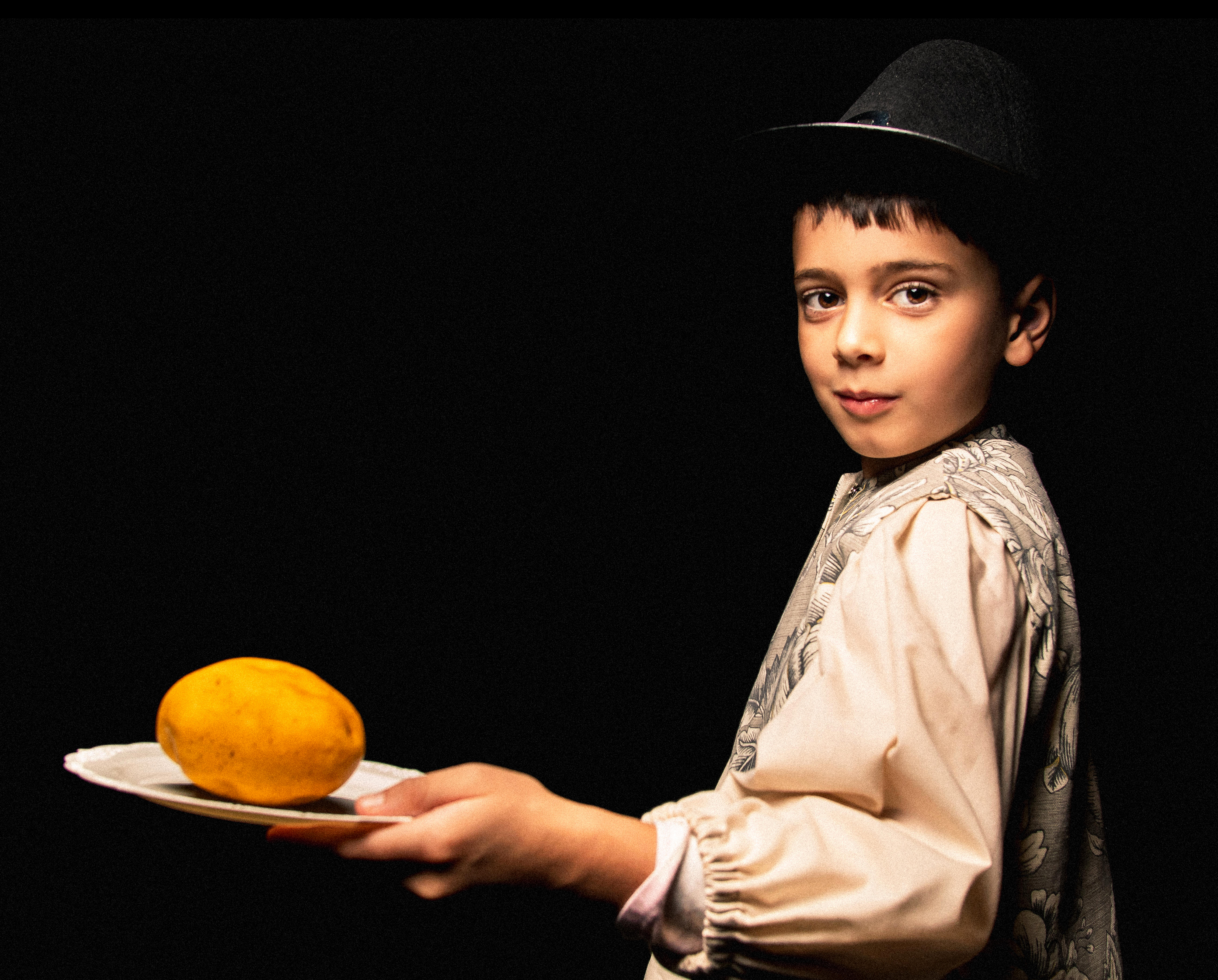
Photograph by Joe Mazza / Brave Lux
Jack Sprat: Introduction
Jack Sprat
Jack Sprat is a spartan eater but his wife Jane loves a fat-rich diet. While Jack would love a simple raw potato for his meal, Jane would prefer a full round of brie cheese. Theirs is a marriage of contradiction, which gives us the perfect opportunity to study opposites. “Jack Sprat could eat no fat,” but “his wife could eat no lean.” “Lean” will most likely be a new word to small children. Teach this new word to them and explore its opposites: oily, greasy, rich.
Many of the foods we eat can be categorized as fatty or lean foods. It would be a good exercise to study the differences between these two types of food (cream, butter, red meat versus celery, broth, carrots). Lean foods tend to be more healthy; this is a valuable lesson to learn at a young age. The old saying, “everything in moderation” is wise advice when we are deciding what to eat!
Opposite Pairs
Organizing opposites in pairs is a great exercise for young children: (big – small), (dull – sharp), (tall – short), (wide – narrow), (loud – quiet), (dark – light), day – night), (new – old), (smooth – rough), (hard – soft), (difficult – easy).
Juniper, Jasmine, Joy
Mother Goose doesn’t tell us Mrs. Sprat’s christian name in her rhyme. But your children could imagine one for her. We’ve met another couple in Rhyming Town and found names for their entire family! Remember the Pumpkin Eaters? Play the same game of alliteration and invent names that begin with “J” to give Jack’s wife: Juniper, Jasmine, Joy, Jean, Jayla, Josephine, Janet, Joan, Jennifer, Jillian, Jessica, Jane, Jenny, Jacqui, Janelle, Juliet, Josie, and Joyce, etc.
Twix the Two
There are two archaic expressions in this rhyme, “twix the two” and “clear the cloth.” “Twix” is an abbreviation of betwixt, which is an old way of saying, “in between.” To “clear the cloth” refers to clearing the table after a meal (“cloth” being the tablecloth). Ask your children if they help “clear the cloth” at home. Bring a tablecloth and cloth napkins into class to do some formal dining in your play kitchen area.
The word “platter” appears in the last line of the rhyme; this is a word we use rarely today. After you explain that it’s a large serving plate, ask if it’s polite to “lick the platter clean.” Miss Natalie and the children pantomime licking the platter clean and laugh at the end of their video. It’s probably funny because it’s something we would never do in polite company!
Proper and Poor Manners
The Sprats’ odious behavior at the dinner table might inspire a conversation about table manners. And since you have just been comparing and contrasting the diets of Mr. and Mrs. Sprat, you could look at “proper” and “poor” table manners. Ask the children to think of examples of poor table manners, such as being late, not washing your hands before the meal, reaching across the table, talking with a mouth full of food, playing with your food, interrupting others when they are speaking, looking at your phone during a meal, blow your nose, burping, or farting at the table.
Then make a list of “proper” table manners: Arrive on time. Wash your hands before eating. Use the words “please,” “thank you,” and “excuse me.” Place your napkin on your lap when you sit down. Wait until everyone is seated before you begin to eat. Keep your mouth closed while you are chewing. Listen to others as they are speaking. Compliment and thank your “host” or “hostess.” When we show that we have polite manners, people are inclined to be pleasant in return.
Practicing Politeness
During the schoolday, practice politeness with your children. Encourage them to use the words “please,” “thank you,” “excuse me” often with each other and their teachers. Play the game “Mother May I?” Something that begins as a fun game could become a good habit. Using the words “please” and “thank you” makes us more gracious people. When we show appreciation and gratitude, we make the world a better place. Encourage your children to try out their especially good manners at home and ask their parents if they see a difference.
The Color Brown
The Sprats are a somber couple, they prefer a simple and unadorned style of dress (compared to The Queen of Hearts, Miss Muffet or the court of Old King Cole). Their favorite color is brown. Have your children think of other things that are brown: chocolate, coffee, hot cocoa, tree bark, acorns, brown bears, dirt, pumpernickel and whole wheat bread, walnuts, chestnuts, buffalo, dogs, violins, chipmunks, pretzels.
Jack Sprat: Discussion
Fat and Lean Foods
“Jack Sprat could eat no fat, His wife could eat no lean.” Can you name some “fat” foods? (butter, cheese, steak, pork, French fries, macadamia nuts, cheesecake, ice cream). Can you name some “lean” foods? (celery, apples, berries, lettuce, pears, oatmeal, beans, fish, tofu).
These words, “fat” and “lean” are “opposites.” They mean completely different things to us. Can you name some other pairs of opposites? Here are some examples: big and small / dull and sharp / tall and short / wide and narrow / loud and quiet / dark and light / day and night / new and old / smooth and rough / hard and soft / difficult and easy.
Juniper, Jasmine, Joy
Mother Goose doesn’t tell us Mrs. Sprat’s christian name in her rhyme. We met another couple in Rhyming Town, do you remember the Pumpkin Eaters? We found names for their entire family that all began with the letter “P”! Let’s play the same game and find a “J” name for Jack’s wife. Examples: Juniper, Jasmine, Joy, Jean, Jayla, Josephine, Janet, Joan, Jennifer, Jillian, Jessica, Jane, Jenny, Jacqui, Janelle, Juliet, Josie, and Joyce, etc.
Twix the Two
What does “twix the two” mean? It’s an old-fashioned way of saying “between.”
Clearing the Cloth
What does it mean to “clear the cloth”? It’s an old-fashioned way of saying “clear the table.” What do you think the “cloth”is in the rhyme? It’s the tablecloth! Do you help clear the cloth at home? Do you take your dish to the kitchen after dinner?
Licking the Platter
What is a platter? It’s a large serving plate, it’s usually oval or round. In the rhyme, Jack and his wife “lick the platter clean.” Does that sound like a polite way to end a meal, to lick the serving plate? Does that sound like “proper” or “poor” table manners?
What are some “proper” table manners?
Arrive on time for dinner.
Wash your hands before eating.
Use the words “please” and “thank you.”
Place your napkin on your lap when you sit down.
Wait until everyone is seated before you begin to eat.
Keep your mouth closed while you are chewing.
Listen to others as they are speaking.
Don’t use a loud voice at the dinner table.
Don’t look at a phone while at the table.
Don’t blow your nose, burp, or fart at the table.
Compliment and thank your “host” or “hostess.”
What are some “poor” table manners?
being late for dinner
having dirty hands or face
reaching across the table
talking with a mouth full of food
poking at or playing with your food
interrupting others when they are speaking
Jack Sprat: Language
KEY RHYMING WORDS
sprat – fat
lean – clean
RESPONSE RHYMES
cat – rat – mat – bat – chat – hat – sat – splat – vat
keen – mean – bean – green – screen – seen – queen – teen – jean – dean – glean
VOCABULARY
“fat” (an oily substance, derived from plants or animals, used in cooking)
”lean” (unfatty, not oily)
“twix” (an abbreviation of betwixt, an old way of saying, “in between”)
“platter”
“proper manners”
“poor manners”
“host”
“hostess”
SIMILIES
fat, oily, greasy, rich
IDIOMS
“to clear the cloth” (table cloth)
“to lick the platter clean” (a large serving plate)
OPPOSITES
This rhyme is based on the comparison of fat versus lean, so it’s the perfect rhyme to focus our attention on words that are opposites.
big – small
tall – short
wide – narrow
high – low
loud – quiet
dark – light
day – night
new – old
smooth – rough
dull – sharp
hard – soft
difficult – easy
up – down
Jack Sprat: Activities
OVERVIEW
Children will practice politeness with the traditional game “Mother May I?” They will explore musical opposites by modulating their tempo, pitch and dynamics. They will explore working together to create interesting opposites of facial and vocal expression, or by using their entire bodies.
1. GAME: Mother May I?
TEACHER: “We’re going to play a game called ‘Mother May I? or ‘Father May I?’. In this game we will take turns being the Mother or Father of the class. We will ask our “parents” if we can take steps toward them. They will tell us how many steps we can take but then they will tell us how we should move. Remember to say “may I” or you’ll have to go “home” and start all over again!”
Children all standing side by side in a line, this is “home.”
1. Teacher selects one child to be Mother (or Father); this child stands alone, a distance from the rest of the class.
2. The Mother (or Father) calls on one of their “children” by name who then asks, “Mother, may I take three steps forward?”
3. If the child asks politely, Mother (or Father) responds with, “Yes, you may take three _____ forward” and adds one of the following movements:
baby steps
giant steps
skipping steps
hops like a bunny
jumps like a frog
crawls like a crab
spins like a top
rolls like a log
leaps like a ballerina
4. If any child forgets to say “may I?” they must return “home.”
5. The first child to reach Mother (or Father) and tag them becomes the new Mother (or Father).
6. Everyone returns “home” and the game begins again.
NOTE: We use the three steps in our example, but Mothers and Fathers can vary this number.
2. GAME: It’s a Fact!
Teacher: “We’re going to play a musical game called ‘It’s a Fact!’ We’ll need to listen closely to the song ‘Jack Sprat’ and when we hear the children shout, ‘It’s a fact!’ we’re all going to do a motion. Before we start, does everyone know what a ‘fact’ is? It’s something that is true. So, what is the opposite of fact? A lie, right?”
Children standing in a circle.
1. Teacher: selects a leader who thinks of a motion and tells it to the class.
Examples:
point toward the middle of the circle
put their hands on their hips
clap their hands
stomp their feet
freeze in place
hold palms upward
throw both arms up in the air
jump up
2. Teacher: plays the song “Jack Sprat” and children dance while listening for the call and response sections.
3. When they hear the children in the recording shout “it’s a fact!” they do the selected motion.
4. Everyone takes a turn leading until the game is over.
3. GAME: Topsy-Turvy
Teacher: “It’s a day of opposites, so we are going to try a game called ‘Topsy-Turvy.’ If I say “stand” you do the opposite and sit. If I say “face me” you do the opposite and look away. Listen closely to my words, it might be hard to do the opposite of what I say!”
Examples:
“up” means “down”
“fast” means “slow”
“sit” means “stand”
“arms in” means “arms out”
“clap loudly” means “clap softly”
“face me” means “turn away”
Children standing in a circle.
1. Play the instrumental version of “Jack Sprat.”
2. Children dance while listening for the Teacher’s instructions.
3. Teacher selects a child to be the next leader of the dance.
4. GAME: Funny Face – Silly Sound
Teacher: “Who wants to play a game called ‘Funny Face – Silly Sound’? We’re going to work in pairs and act in front of our class.”
Children seated like an audience facing a stage.
1. Teacher stands on stage and asks for a volunteer.
2. Teacher and child face the audience to model the game. The Teacher makes a funny face and the child responds with a silly sound. Then they both do this at the same time.
2. Teacher asks for a second volunteer to the stage and steps aside.
3. The first child makes a funny face.
4. The second child responds with a silly sound.
5. Teacher counts: “3, 2, 1, action!” and the children do it at the same time!
6. Repeat this action a few times.
7. These two children take bows and two new volunteers are chosen.
Jack Sprat: Music
THE MUSIC
How does this music make you feel?
Is this music slow or fast?
Does it change your mood?
What pictures does this music create in your mind?
Do you imagine a particular place, person, thing, color, animal, etc.?
How would you move to this music?
THE INSTRUMENTS
What instruments do you hear, can you name them?
How do you think the instruments make their sounds?
Are they blown through, plucked, strummed, bowed, tapped, hit, or struck?
Are these instruments made of wood or metal?
Trumpet
The trumpet is a brass instrument commonly used in classical and jazz ensembles. Sound is produced by vibrating the lips in a mouthpiece. The trumpet makes the highest sounds in the brass instrument family.
Trombone
The trombone is a brass instrument commonly used in classical and jazz ensembles. Sound is produced by vibrating the lips in a mouthpiece. The trombone typically does not have any buttons or valves and uses a slide to change pitches.
Saxophone
The saxophone is a woodwind instrument that is most often used in concert bands and jazz ensembles. To make sound saxophones have a single reed on the mouthpiece that vibrates. There are three common types of saxophones that vary in size: Alto, Tenor, and Bari. In this video you will see Tenor Saxophone.
Piano
The piano is a keyboard instrument that produces sound by hammers striking strings when the keys are pushed down. Most pianos have 88 black and white keys. In this video you will see an upright piano that is smaller than a grand piano but larger than an electric keyboard.
Acoustic Guitar
The guitar is a stringed instrument that typically has six strings and is played by strumming or plucking with one hand while using the fingers of the other to press the strings in various combinations to make chords.
Electric Bass
The electric bass is a stringed instrument with four metal strings that the player strums or plucks, that sound is then played through an electric amplifier. The guitar has six strings and the bass has only four.
Drum Set
A collection of drums and cymbals set up to be played by one person. The drummer uses drumsticks in their hands, operates a pair of cymbals, and plays the bass drum with their feet.
GENRE: Funk
Funk is a musical style that originated in the 1960’s and combines several other popular genres into a rhythmic and danceable style. Funk music focuses less on melodies and chord progression and more on rhythmic groove utilizing complex percussion parts.
LESSON 1: Call and Response
There is a strong call and response section to “Jack Sprat” in the simple refrain, “Jack Sprat…it’s a fact!” Children will enjoy participating in this syncopated interplay of voices. You’ll find a game called “It’s a Fact” in the ACTIVITIES section of this teaching guide that pairs movement with call and response.
Jack Sprat: Related Rhymes
Here are two parallel Mother Goose rhymes about peculiar married couples and food in a bygone era.
When I Was a Little Boy
When I was a little boy,
I lived by myself,
And all the bread and cheese I had
I put upon a shelf.
The rats and the mice,
They made such a strife,
I had to go to London
To get myself a wife.
The streets so broad,
And the lanes so narrow,
I had to bring her home
In an old wheelbarrow.
Said John to Joan
Said John to Joan, will you marry me?
My cow, my calf, my house, my rents,
And all my land and tenements,
My Joan, will that not do?
I cannot come each day to woo.
I’ve corn and hay in the barn hard by,
And three fat hogs pent up in a sty.
I have a mare, and she’s coal black,
I ride on her tail to save her back.
I have cheese upon the shelf,
And I cannot eat it all myself.
I’ve three good coins tied in a rag
In the nook of the chimney instead of a bag.
Jack Sprat: Standards
Head Start Early Learning Outcomes Framework (ELOF)
Preschool Language and Literacy 7 | Child shows understanding of word categories and relationships among words. |
Preschool Scientific Inquiry 3 | Child compares and categorizes observable phenomena. |
Preschool Approaches to Learning 11 | Child shows interest in and curiosity about the world around them. |
Preschool Social and Emotional Development 2 | Child engages in prosocial and cooperative behavior with adults. |
Preschool Language and Literacy 5 | Child asks and answers questions about a book that was read aloud. |
The Head Start Early Learning Outcomes Framework: Ages Birth to Five (ELOF) presents five broad areas of early learning, referred to as central domains. The framework is designed to show the continuum of learning for infants, toddlers, and preschoolers. It is grounded in comprehensive research around what young children should know and be able to do during their early years.
The Head Start Program Performance Standards require grantees to implement program and teaching practices that are aligned with the ELOF. Education managers use the ELOF Implementation Toolkit to guide the alignment process and help their programs strengthen practices to promote children’s development in all ELOF domains.
The Cabinet of Wonder teaching guides are in alignment with Head Start’s ELOF. They have been designed to enhance any standard preschool curriculum by assisting teachers and families in both meeting school readiness goals and developing a joyful learning journey!