

TEACHING GUIDE 12
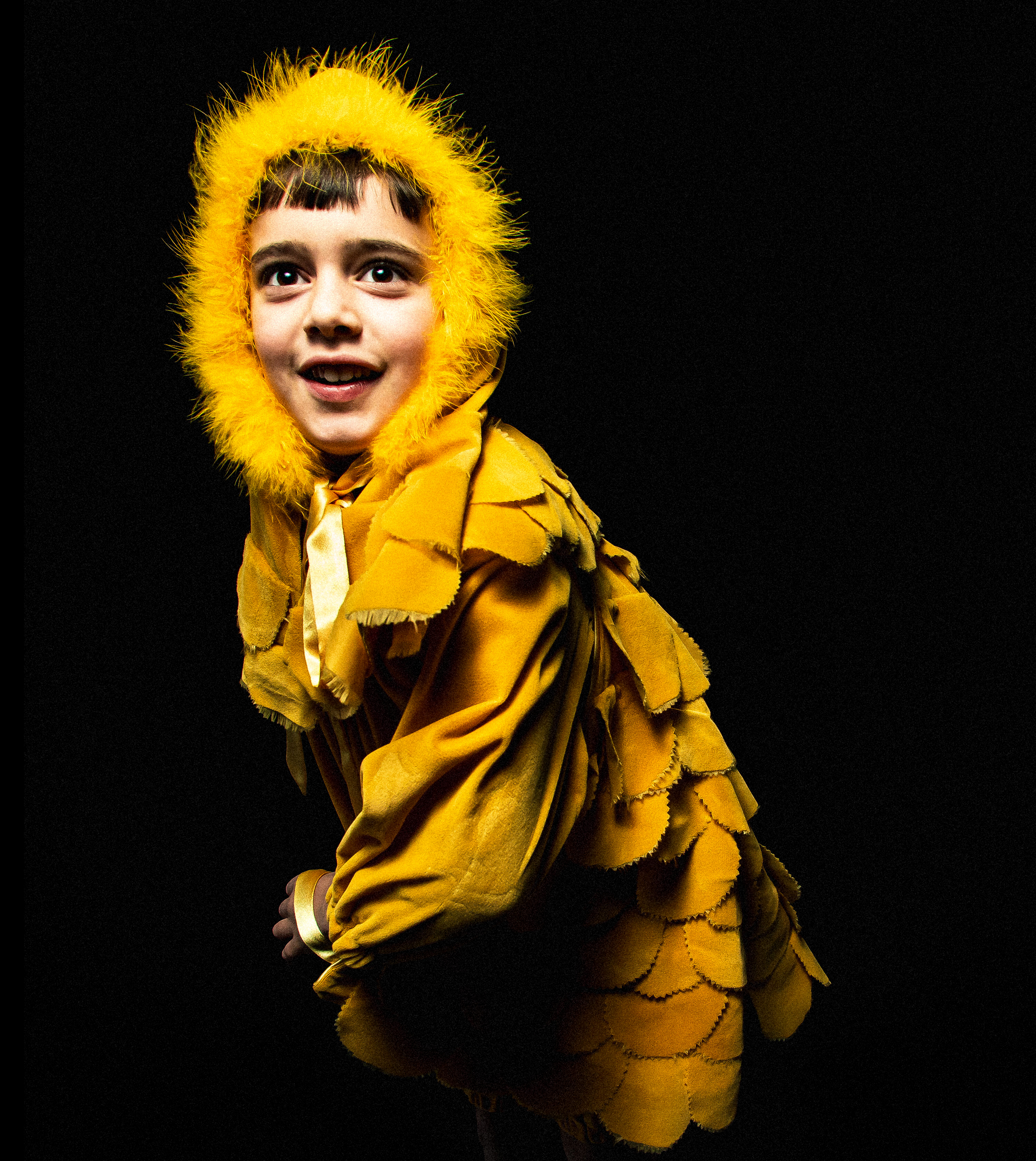
Mary had a pretty bird,
Feathers bright and yellow.
Slender legs, upon my word,
He was a pretty fellow.
Photograph by Joe Mazza / Brave Lux
Mary Had a Pretty Bird: Introduction
Mary Had a Pretty Bird “Mary Had a Pretty Bird” is one of the lesser known nursery rhymes in the Cabinet of Wonder series. This sweet and simple verse is set to an infectious folk melody that is perfectly paced for circle and partner dancing. In the music video, The Pretty Bird is not caged, he is Mary’s free and equal companion. The two friends perch side by side on a tree limb, they dance and play hand clapping games or hide-and-seek around a stand of giant foxgloves (foxglove is a fanciful flower name for children to learn). This rhyme and video can open up conversations about the joys of friendship, wild animals versus pets, the color yellow, new words, “slender” and “fellow,” and the charming expression “upon my word!” The Color Yellow Mary’s bird is famously pretty and yellow (canary we don’t know). Your children can explore other things that are the color yellow: the sun, sunflowers, lemons, bananas, daffodils, egg yolks, bumblebees, dandelions, corn, chicks, rubber duckies. Draw and paint these objects with your class; make a bright and beautiful display of all the yellow things you can name. The Word “Slender” Learn about the word “slender” and its synonyms (slim, thin, skinny, lean, spindly, narrow, wafer-thin). There is another word that may not be common in the vocabulary of young children: “fellow.” “Fellow” is another word for man. People also use “fellow” as a term of endearment for a congenial person. Maybe your children have heard the song, “For He’s a Jolly Good Fellow?” When we feel a shared sense of love and support within a community, we call it “fellowship.” Upon My Word! An expression that appears in the rhyme that may be confusing to young children is “upon my word,” which is an outmoded expression that can be used as a pledge of sincerity. “Upon my word” could be interpreted as “I really mean it” or “I’m definitely telling the truth.” Rhyming Pairs Naming pairs of rhyming words in Mother Goose poems is a fun exercise. Some rhyming words for ”bird” and “word,” are: curd, third, heard, stirred, and blurred. Other rhymes for “yellow” and “fellow” are: mellow, bellow, cello, Jello, and hello. A Circle Dance Children will see a circle dance (with Mary in the center) in the music video. Circle-up with your class and dance to this infectious folk melody. Circle to the left, circle to the right, draw into the center and back out again. Children will love this! Add improvisations and make a dance of your own. Have each child take a turn as the “leader” who calls out the motions. A Partner Dance Children will see Mary and The Pretty Bird partner dance in the music video. Teach your class some basic square dance moves to try out such as do-si-do and promenade. Have your children pair up and swing their partners. Mary and The Pretty Bird play hide-and-seek, a playground favorite. There is also a brief hand clapping game. Young children love trying their hand at simultaneous chanting and hand clapping with a partner. Some useful rhymes appear below in the ACTIVITIES section of this teaching guide. The Flute and Fiddle In the musical arrangement of “Mary Had a Pretty Bird,” the flute and the fiddle seem to be in conversation as they exchange melodic lines. The flute imitates the sound of The Pretty Bird singing. Birds have special calls that they use to communicate with their partners, their young, and other members of their flock. It would be interesting to listen to recordings of birdcalls, especially the varied and complex songs of canaries. Flocking Play a game of “flocking” with your children. This is a graceful game of follow-the-leader in which one child moves at the front of the group and all imitate their movements (like a bird leading a flock). Some beautiful choreography results from this creative game. A Little Bird Told Me There are many interesting figures of speech in English that involve birds. Here are a few examples: “the early bird gets the worm,” “a bird in the hand is worth two in the bush,” “birds of a feather flock together,” “a bird’s eye view,” “a little bird told me,” “free as a bird,” “a night owl.” Help your children to understand the meanings of these expressions and glean their bits of wisdom.
Mary Had a Pretty Bird: Discussion
Wild Animals and Pets
Do you think Mary’s pretty bird playmate is a wild animal or a pet? Do you have any pets? What wild animals have you seen? Examples: chipmunks, deer, rabbits, frogs, raccoons, mice, bear, moose, snakes, butterflies, grasshoppers, etc.
The Color Yellow
Mary’s bird is famously pretty and yellow. Ask your children to think of things that are the color yellow (the sun, sunflowers, lemons, bananas, daffodils, canaries, egg yolks, bumblebees, dandelions, corn, chicks, rubber duckies, etc.).
Slender and Fellow
What does the word “slender” mean? Can you think of any similar words? What does the word “fellow” mean? What are some similar words?
Upon My Word
What does the expression “upon my word” mean?
The Early Bird
There are many idioms in English that involve birds. Here are a few examples: “the early bird gets the worm,” “a bird in the hand is worth two in the bush,” “birds of a feather flock together,” “a bird’s eye view,” “a little bird told me,” “free as a bird,” “a night owl.”
Mary Had a Pretty Bird: Language
KEY RHYMING WORDS
bird – word
yellow – fellow
RESPONSE RHYMES
curd – third – heard – stirred – blurred
mellow – bellow – cello – jello – hello
VOCABULARY
“slender”
“fellow”
IDIOMS:
“upon my word!”
“the early bird gets the worm”
“a bird in the hand is worth two in the bush”
“birds of a feather flock together”
“a bird’s eye view”
“a little bird told me”
“free as a bird”
“night owl”
Mary Had a Pretty Bird: Activities
OVERVIEW In the following activities children will think of all things the color yellow and make decorations for their classrooms. They will circle and partner dance, and play a game that helps them identify the refrain of the song. They will play flocking and hand clapping games. They will form closer bonds with their classmates through cooperative play. 1. CRAFT: Mary’s Bird is Yellow Mary’s Pretty Bird is yellow. Once you have made a list of things that are yellow, why not draw and paint these objects with your children? Make a bright and beautiful display of all the yellow things you can name: the sun, sunflowers, lemons, bananas, daffodils, canaries, egg yolks, bumblebees, dandelions, corn, chicks, rubber duckies, and more. 2. DANCE: Circle Dancing Children will see a circle dance (with Mary in the center) in the rhyme teaching video. Definitely circle-up with your class and dance to this infectious folk melody. Circle to the left, circle to the right, draw into the center and back out again (children absolutely love this). Add improvisations and make a dance of your own. Pick a leader to call out the motions. Teacher: “This is a song for dancing, so we are going to learn a circle dance just like the children did in Miss Natalie’s room in the video!” Standing in a circle holding hands. 1. Play the “Mary Had a Pretty Bird” song. 2. Teacher: Lead your children in clockwise circle dance (“Ring Around the Rosie” style). When the repeated chorus arrives, everyone walks toward the middle of the circle. Children take three steps forward (counting 1, 2, 3) and stop on the fourth. They bring their hands together in the center of their circle. Then walk backward f(counting 1, 2, 3) and stop on the fourth. 3. Do this twice during every chorus. 4. Resume walking in your clockwise circle during the verses. 3. DANCE: Partner Dancing Children will see Mary and The Pretty Bird partner dance in the music video. Have your children pair up and try swinging their partner, teach them to do-si-do and promenade (square dance terms). 4. GAME: Freeze Dance Teacher: “Let’s play a game called ‘Freeze Dance.’ Move to the music and when I say freeze, stand still like a statue.” Everyone standing. 1. Play the song, “Mary Had a Pretty Bird.” 2. Ask your children to dance to the music. 3. When the chorus of the song comes in (“Mary had a pretty bird, Mary had a pretty bird. Mary had a pretty bird, Mary had a pretty bird.”), everyone freezes! 5. GAME: Pass the Pretty Bird Materials: a toy bird Teacher: “We’re going to play a game called ‘Pass the Pretty Bird.’ Everyone has to work together to pass this pretty little bird around our circle. When the music stops and you are the one holding him, you get to solo dance in the middle!” Seated in a circle. 1. Play the “Mary Had a Pretty Bird” song. 2. Children will pass the toy bird around their circle. 4. When the Teacher pauses the music the child with the bird steps into the center of the circle and does a solo happy dance holding the bird. 6. This child rejoins the circle and the game begins again. 7. Repeat until all students have had a spotlight moment. 6. ACTIVITY: Flocking Play a game of “flocking” with your children. This is a graceful game of follow-the-leader in which one child moves at the front of the group and all others imitate their movements (just as a bird leads a flock). Some beautiful spontaneous choreography results from this creative game. 7. ACTIVITY: Hand Clapping Games Young children love to try their hand at simultaneous chanting and hand clapping with a partner. Here are some useful rhymes for hand clapping games. Pease Porridge Pease porridge hot, Pease porridge cold, Pease porridge in the pot, Nine days old. Some like it hot, Some like it cold, Some like it in the pot, Nine days old. Pat-a Cake Pat-a-cake, pat-a-cake, baker’s man, Bake me a cake, as fast as you can; Pat it, prick it, and mark it with B, Put it in the oven for baby and me. Cuckoo, Cherry Tree Cuckoo, Cherry tree, Catch a bird And give it to me. Big A, Little a Big A, little a, bouncing B, The cat’s in the cupboard, and she can’t see.
Mary Had a Pretty Bird: Music
THE MUSIC
How does this music make you feel?
Is this music slow or fast?
Does it change your mood?
What pictures does this music create in your mind?
Do you imagine a particular place, person, thing, color, animal, etc.?
How would you move to this music?
How would you move your hand in the air if you were conducting this song?
THE INSTRUMENTS
What musical instruments do you hear, can you name them?
How do you think the musical instruments make their sounds?
Are they blown through, plucked, strummed, bowed, tapped, hit, or struck?
What instrument families do these instruments belong to?
Are these instruments made of wood or metal?
Does this musical instrument play high or low pitches?
Flute
The flute is a member of the woodwind family, even though it is typically made of metal. To make a sound on the instrument you blow air across an open hole, the air vibrates to create the sound. The flute is one of the oldest instruments with most cultures around the world having their own version of a flute.
Fiddle
The fiddle is another name for a violin that is used in certain genres of music. To play a fiddle/violin you pull a bow made of horsehair across the strings and use your fingers on the other hand to make the strings longer or shorter.
Acoustic Guitar
The guitar is a stringed instrument that typically has six strings and is played by strumming or plucking with one hand while using the fingers of the other to press the strings in various combinations to make chords.
Double Bass
The double bass (sometimes just called bass) is the lowest instrument in the string family. The bass is most often found in classical and jazz music. It can be played by pulling a horsehair bow across the strings or by plucking the strings individually.
Drum Set
A collection of drums and cymbals is set up to be played by one person. The drummer uses drumsticks in their hands, operates a pair of cymbals, and plays the bass drum with their feet.
GENRE: Contemporary Folk
Mary Had a Pretty Bird: Related Rhymes
“Two Birds on a Stone” is a fun rhyme to chant with illustrative hand gestures.
Two Birds on a Stone
There were two birds sitting on a stone.
One flew away, and then there was one.
The other flew away, and then there was none.
So, the poor little stone was left all alone.
One of these birds back again flew,
The other came after, and then there were two.
Said one to the other, “How do you do?”
“Very well, thank you, and how are you?”
“Rings on Her Fingers” is another sweet and simple Mother Goose rhyme about a little girl.
“Girls and Boys, Come Out to Play” is about friendship and play.
Rings on Her Fingers
With rings on her fingers
And bells on her toes,
And she shall have music
Wherever she goes.
Girls and Boys, Come Out to Play
Girls and boys, come out to play,
The moon does shine as bright as day.
Leave your supper and leave your sleep,
And come meet your playfellows down the street.
Come with a whoop, and come with a call,
And come with good will or not at all.
Up the ladder and down the wall,
A halfpenny roll will serve us all.
You find milk and I’ll find flour,
And we’ll have pudding in half an hour.
Mary Had a Pretty Bird: Standards

Head Start Early Learning Outcomes Framework (ELOF)
Preschool: Social and Emotional Development 3 | Child engages in and maintains positive interactions and relationships with other children. |
Preschool: Scientific Inquiry 3 | Child compares and categorizes observable phenomena. |
Preschool Language and Literacy 6 | Child understands and uses a wide variety of words for a variety of purposes. |
Preschool Language and Literacy 7 | Child shows understanding of word categories and relationships among words. |
Preschool Perceptual, Motor, and Physical Development 1 | Child demonstrates control, strength, and coordination of large muscles. |
Preschool Approaches to Learning 13 | Child uses imagination in play and interactions with others. |
Preschool Language and Literacy 5 | Child asks and answers questions about a book that was read aloud. |
The Head Start Early Learning Outcomes Framework: Ages Birth to Five (ELOF) presents five broad areas of early learning, referred to as central domains. The framework is designed to show the continuum of learning for infants, toddlers, and preschoolers. It is grounded in comprehensive research around what young children should know and be able to do during their early years.
The Head Start Program Performance Standards require grantees to implement program and teaching practices that are aligned with the ELOF. Education managers use the ELOF Implementation Toolkit to guide the alignment process and help their programs strengthen practices to promote children’s development in all ELOF domains.
The Cabinet of Wonder teaching guides are in alignment with Head Start’s ELOF. They have been designed to enhance any standard preschool curriculum by assisting teachers and families in both meeting school readiness goals and developing a joyful learning journey!