

TEACHING GUIDE 14
There was a crooked man,
And he walked a crooked mile.
He found a crooked sixpence,
Beside a crooked stile.
He bought a crooked cat
Which caught a crooked mouse.
And they all lived together
In a crooked little house.
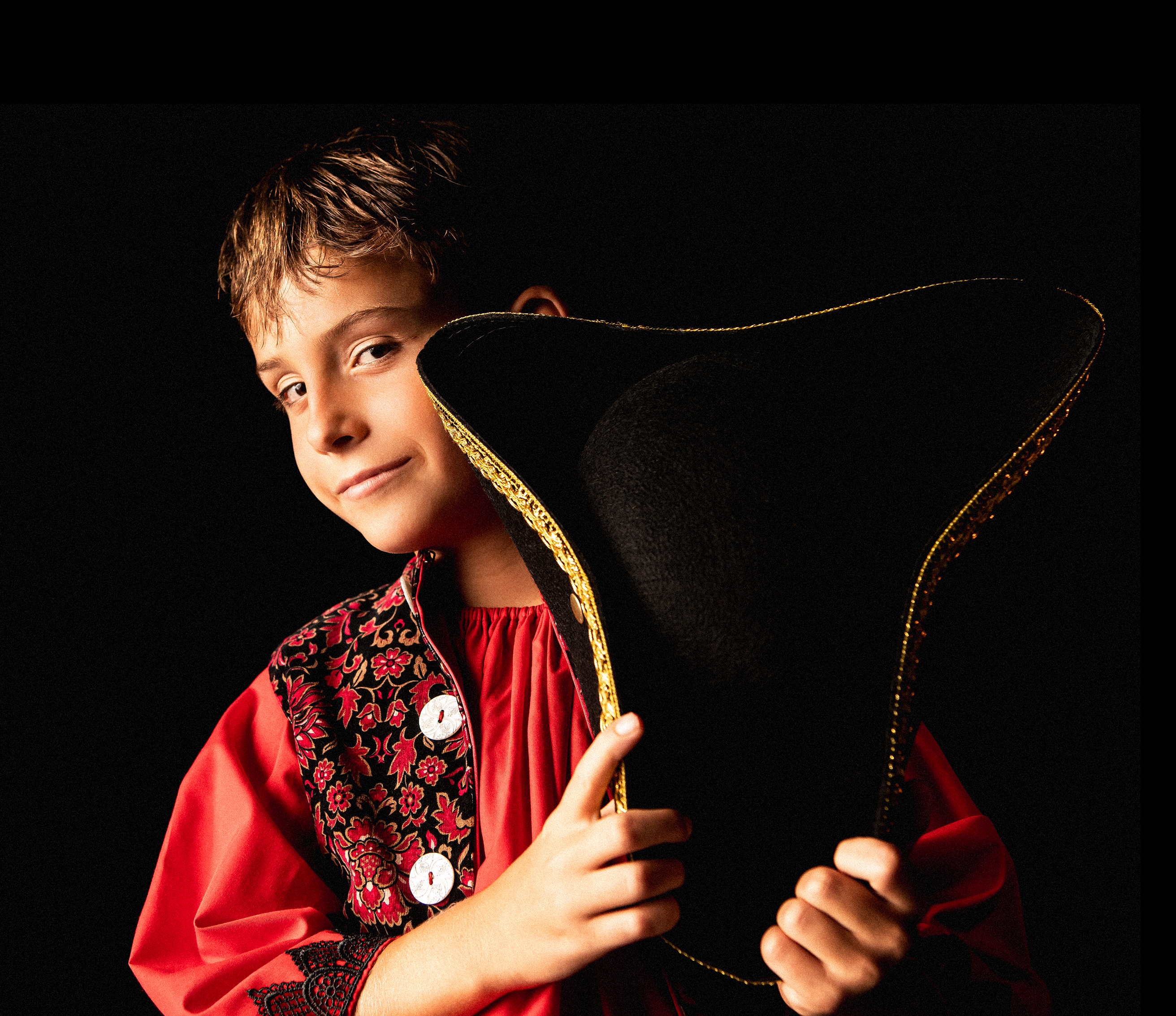
Photograph by Joe Mazza / Brave Lux
A Crooked Man: Introduction
A Crooked Mile
The Crooked Man is a Mother Goose character who is famous for the crooked mile he walked. Just as we studied the measurement of time with “Hickory Dickory Dock” (seconds, minutes, hours) we will now turn our attention to measuring space. Before children can measure a mile, they will need to be familiar with inches, feet, and yards. Before conceiving of long distances beyond the walls of their classroom, they can first measure the length of a crayon. Maybe crayon lengths could be their first system of measurement? How many crayons (laid end-to-end) equal the length of a table top? Think of a landmark, one mile’s distance from your school and imagine how many crayons would be needed to reach that!
Two Ways of Measuring
Show your children a tape measure, and the two sides with different systems of measurement: Imperial System: inches, feet, yards and Metric System: millimeters, centimeters, decimeters, meters. Explain that The Metric System is also called The International System because nearly everyone in the world (95%) uses it. Make a chart of your children’s heights and keep track of their growth throughout the school year in inches and centimeters.
Maps and Legends
We know where we are, where we want to go and how to get there by using maps. Show your children a colorful map of your region and locate your town or city. Point out the little box with the map’s “legend” or “key.” Decode all the symbols and patterns of the map that represent roadways, cities, rivers, lakes, mountains, parks, and places of interest. Make your own map of your classroom or school together. Be sure to include familiar features such as the block area, cubbies, sinks, playground, important trees, parking lots, front entrance, hallways, and classrooms. Why not make a map of Rhyming Town with all the homes of the Mother Goose characters?
Walk a Mile in My Shoes
Take a moment to explain some of the traditional sayings that refer to miles and roads: “you missed it by a mile,” “walk a mile in my shoes,” “we’ve been down this road before,” “it’s just a bump in the road.”
A Penny for Your Thoughts
On his walk, the Crooked Man found a crooked sixpence beside a crooked stile. The words “sixpence” and “stile” reveal Mother Goose’s origins in England. A “pence” is a British penny and a “sixpence” is an outdated coin that was once worth six pennies. Take a moment to look closely at a penny, a nickel, a dime, a quarter and a dollar coin with your children. Explain that the faces they see stamped into the metal are of famous people. You can point out that on American coins, we see Presidents and on English coins, kings and queens (with the exception of the US dollar coin which features the Shoshone guide Sacagawea and other Native American themes).
We find coinage and currency at the root of many old English expressions. Here are some examples: “a penny saved is a penny earned,” “money doesn’t grow on trees,” “a penny for your thoughts,” “penny pincher” and “penny pinching.”
A “stile” is a set of steps that allow people, but not animals, to climb over a fence or wall.
Worth a Grain of Salt
Children will be surprised to learn that in ancient times, some items that were used as money were sea shells, glass beads, pebbles, grain, salt, cattle, cocoa beans, clay tokens, precious stones, animal pelts, even whale’s teeth! What could you use as a new form of exchange in your classroom (Legos, wooden blocks, crayons)?
If you happen to have any foreign bills or coins stashed in a drawer at home, bring them into class for your children to inspect. They will have fun seeing other currencies used around the world. Design and print your own form of currency!
Crooked vs. Straight
In this rhyme, the man, his cat, his mouse, and his house are all “crooked.” What is the opposite of “crooked?” This comparison will be a springboard for naming more pairs of opposites: (buy – sell, ceiling – floor, front – back, full – empty, tall – short, big – small, thick – thin, wide – narrow, old – new, in – out, up – down, wide – narrow, loud – quiet, day – night, hard – soft, top – bottom, neat – sloppy).
Tricorn Tricycle Triangle
In the music video, Mother Goose and the Crooked Man are both wearing “tricorn hats.” The prefix “tri” means three; the hat has three corners. It’s worth mentioning that a tri-cycle is a bike with three wheels and a tri-angle is a shape with three sides.
The tricorn was very popular with gentlemen, commoners, soldiers, and pirates in Mother Goose’s time (18th century). Children will notice that the style of dress in Rhyming Town is very different from today. Our characters wear bonnets, capes, and vests, blouses and skirts have ample gathers and hems are ankle length. These costumes are not “modern,” they are “old fashioned.” Being able to recognize historical period costumes is a gateway to studying history.
A Spirited March
The musical arrangement for “A Crooked Man” is a spirited march and children will be energized by it. They can practice marching in place, marching in a circle, marching in a straight line, marching in a crooked line, and following the leader. While they are marching, have them count “1, 2, 3, 4” in time with the music. Form a parade and lead your little troopers through the hallways and out the door onto the playground for recess!
A Crooked Man: Discussion
A Crooked Mile
The Crooked Man walked a crooked mile. Remember when we learned “Hickory Dickory Dock” and we talked all about clocks and the ways people measure time? Now we are going to talk about measuring space.
Have you ever heard of inches, feet, yards, miles? We use these units to measure distance (as we use seconds, minutes, hours, days, months, years to measure time).
Let’s use a crayon to measure this table. How many crayons do we need to put in a long row to measure this table top? How many crayons from the table to the sink? How many crayons from our classroom to the front door of the school? How many crayons from our school to your house? How many crayons tall are you?
Two Ways of Measuring
This is a tape measure. It has two sides with different systems of measurement. Imperial System: inches, feet, yards and Metric System: millimeters, centimeters, decimeters, meters. Most of the people in the world use the Metric system.
Keeping Track
Let’s make a chart on this wall to keep track of how much you all grow before the end of the school year. We’ll use inches and centimeters.
Maps and Legends
How do we know where, where we want to go and how to get there? We use maps. This is a map of our area, this is our town and this dot here is our school. Do you see this little box in the bottom corner of the map? This is called the legend or key. A legend is a code to explain all the symbols and patterns on a map. What do you think all these little pictures represent? (roads, cities, rivers, lakes, mountains, parks, and interesting places to visit).
Let’s make a map of our classroom together. We’ll want to draw the tables, chairs, the rug, the sink, the dress up box, the building block area, the coatroom, and our cubbies.
Let’s make a map of our whole school now. We’ll draw the parking lot, the playground, the big maple trees, the front door, the hallways, and all the classrooms.
Let’s make a map of Rhyming Town with all the homes of the Mother Goose characters?
Walk a Mile in My Shoes
Have you ever heard the old saying “Walk a mile in my shoes?” What do you think it means? How about “You missed it by a mile?” “We’ve been down this road before?” or “It’s just a bump in the road?”
A Penny for Your Thoughts
While the Crooked Man was walking his crooked mile, he found a crooked sixpence beside a crooked stile. A “pence” is a British penny and a “sixpence” is a coin that was worth six pennies.
Have you ever looked at a penny, a nickel, dime, quarter or dollar coin? Did you notice there are faces stamped into the metal? These are famous people. On most American coins, we see Presidents and on English coins, kings and queens. But look at this dollar coin? Do you see how different it is? It has a picture of a woman holding her baby. Her name is Sacagawea, she was a famous Native American explorer.
Have you ever heard anyone say,“a penny saved is a penny earned” or “money doesn’t grow on trees,” “a penny for your thoughts,” “penny pinching? ”What do you think they meant?
What do you think a crooked “stile” is? If you were walking through a farm in England, you would be able to climb over the fences on steps, called stiles. Stiles keep the farm animals inside the fence but let people cross over.
Worth a Grain of Salt
Did you know that long ago, before there were metal coins, people used other things for money like sea shells, glass beads, pebbles, grain, salt, cattle, cocoa beans, clay tokens, precious stones, animal pelts, even whale’s teeth!
What could we use as money in our classroom (Legos, wooden blocks, crayons)?
Let’s make our own paper money. What can we draw on it?
Crooked vs. Straight
In this rhyme, the man, his cat, his mouse and his house are all “crooked.” What is the opposite of “crooked?” (straight)
Can we think of other words that are opposites? (buy – sell, ceiling – floor, front – back, full – empty, tall – short, big – small, thick – thin, wide – narrow, old – new, in – out, up – down, wide – narrow, loud – quiet, day – night, hard – soft, top – bottom, neat – sloppy).
Tricorn Tricycle Triangle
Mother Goose and the Crooked Man are both wearing “tricorn hats.” This hat has three corners and is called a “tricorn hat.” If we put “tri” at the front of a word it means three. A tri-cycle is a bike with how many wheels? A tri-angle is a shape with how many sides?
This sort of hat was very popular in Mother Goose’s time. Do the folks in Rhyming Town dress differently than we do? Do we wear bonnets and capes to school? Do our skirts come down to our ankles? These costumes are not “modern,” they are “old fashioned.”
A Spirited March
“A Crooked Man” is a marching song. Let’s practice marching in place! Let’s march in a circle! Let’s march in a straight line! Now, let’s march in a crooked line! Let’s swing our arms and count “1, 2, 3, 4”. Let’s make a parade and follow the leader, let’s march right outside to the playground for recess!
A Crooked Man: Language
KEY RHYMES
mile – stile
mouse – house
RELATED RHYMING WORDS
smile – file – tile – Nile – while
blouse – louse – grouse
VOCABULARY
“legend”
“key”
“six-pence”
(a “pence” is an English penny, a “sixpence” is an outdated British coin worth six pennies that was withdrawn in 1980)
“stile”
(a set of steps that allow people, but not animals, to climb over a fence or wall)
“tricorn”
“tricycle”
“triangle”
“modern”
“old fashioned.”
OPPOSITES
crooked – straight
buy – sell
ceiling – floor
front – back
full – empty
tall – short
big – small
thick – thin
wide – narrow
old – new
in – out
up – down
wide – narrow
loud – quiet
day – night
hard – soft
top – bottom
neat – sloppy
IDIOMS
“you missed it by a mile”
“walk a mile in my shoes”
“we’ve been down this road before”
“it’s just a bump in the road”
“a penny saved is a penny earned”
“money doesn’t grow on trees”
“a penny for your thoughts”
“a penny pincher”
“penny pinching”
A Crooked Man: Activities
OVERVIEW
“A Crooked Man” is not a song for sitting still; children will march in place, march around the classroom, and parade out into the playground! They will play games that use parts of their bodies to keep a steady beat. They will follow the leader and try walking crooked. In a magical game, they will be inspired by a traveling drum to visit exotic lands in their imaginations. Let’s get started on our trip to Tiptoe Island and Upside Down Town.
1. ACTIVITY: Marching
Here are some marching suggestions!
1. Pick a leader and have the entire class march behind them. The children will enjoy weaving a path between chairs and tables, swinging their arms, lifting their knees high, and pretending to move the slides of their imaginary trombones. Have them count “1, 2, 3, 4” in time with the music.
2. Use tape to make a crooked line on the floor and have the children march along it.
3. Children can contort their bodies and pretend to be crooked while they march.
4. Children pantomime the rhyme, making cat ears with their hands, catching the mouse, and drawing the shape of a crooked house in the air with their fingers (as Mother Goose does in the music video).
2. ACTIVITY: Ready, Steady, Go!
Teacher: “This song has a strong steady beat. Let’s tap the steady beat on different parts of our bodies. Ready, steady, go!”
In a standing circle.
1. Play the song “A Crooked Man.”
2. Ask children to do a motion to the steady beat:
Examples:
clap their hands
slap their thighs
tap their knees
pat their heads
pat their shoulders
stomp their feet
3. ACTIVITY: The Big Parade
Materials:
rhythm instruments or any classroom object that can be used as one
Teacher: “This song is a marching song. Let’s pretend we’re in a parade and march and play our instruments in time with the song.”
Standing in line.
1. Distribute instruments to the children.
2. Line up to become a parade.
3. Play the song “A Crooked Man.”
4. Children march around the classroom, while keeping a steady beat on their instruments.
4. GAME: Traveling Drum*
Materials:
a drum
Teacher: “This is a traveling drum. This drum can take us to all sorts of places. First we need to close our eyes and count to three and then we will travel while I play the drum.”
Seated in a circle with plenty of space to move.
1. Begin the game by softly drumming a pattern; ask your children to close their eyes and count backwards from three.
2. Ask them to open their eyes and say, “you have travelled to a new land, we are in _________________________________.” Insert one of these destinations:
Tiptoe Island (quick, short movements)
Gallop City (galloping and trotting)
Upside Down Town (hanging heads and hands down)
Big Boulder Mountain (pushing and pulling rocks out of the way)
Down Low Soggy Bog (crawling, rolling, and scooting)
Way High Sky (standing on tiptoes, floating, flying, jumping, and leaping)
1. Ask the children to demonstrate what kind of movement happens there.
2. Begin to drum the pattern again and ask the children to move about the room using the movement of this new land.
3. Pause your drumming and have the children freeze in place and sit down wherever they are in the room.
4. Rest after each imaginary trip.
5. Repeat.
*Traveling Drum was created by Amanda Pintore
5. GAME: A Crooked Walk
Materials:
dots, cones, or other objects for marking space
Teacher: “We are going to play a game called ‘Crooked Walk Challenge.’ We’ll have to work together in pairs and really trust each other during this game.”
Preparation:
Mark points A to B with cones or dots or other objects found in your room.
Children lined up in pairs at point A.
1. Two volunteer children model walking while leaning into each other from point A to B.
2. Play the song “A Crooked Man.”
3. In duos, children will lean into each other as partners, and walk from point A to B.
4. Teacher: Pause the music when everyone has reached point B.
5. Repeat, but this time moving from point B to A and pairs leaning back-to-back.
A Crooked Man: Music
THE MUSIC
How does this music make you feel?
Is this music slow or fast?
Does it change your mood?
What pictures does this music create in your mind?
Do you imagine a particular place, person, thing, color, animal, etc.?
How would you move to this music?
How would you move your hand in the air if you were conducting this song?
THE INSTRUMENTS
What musical instruments do you hear, can you name them?
How do you think the musical instruments make their sounds?
Are they blown through, plucked, strummed, bowed, tapped, hit, or struck?
What instrument families do these instruments belong to?
Are these instruments made of wood or metal?
Does this musical instrument play high or low pitches?
Trumpet
The trumpet is a brass instrument commonly used in classical and jazz ensembles. Sound is produced by vibrating the lips in a mouthpiece. The trumpet makes the highest sounds in the brass instrument family.
Trombone
The trombone is a brass instrument commonly used in classical and jazz ensembles. Sound is produced by vibrating the lips in a mouthpiece. The trombone typically does not have any buttons or valves and uses a slide to change pitches.
Tuba
The tuba is the largest and lowest pitched instrument in the brass family. To make a sound the player vibrates their lips into the mouthpiece like other brass instruments. The tuba typically has three valves to change the pitch.
Bass Clarinet
The bass clarinet is a member of the woodwind family and most closely related to the soprano clarinet. This instrument produces sound by having a single reed vibrate against the mouthpiece when the player blows air into it. The bass clarinet is longer and larger than the soprano and its mouthpiece is mounted on a metal tube. Due to its size, the bass clarinet can play lower pitches.
Bassoon
The Bassoon is a member of the woodwind family and uses a double reed to make sound. The player uses their air to vibrate two pieces of bamboo cane that are tied together.
Piano
The piano is a keyboard instrument that produces sound by hammers striking strings when the keys are pushed down. Most pianos have 88 black and white keys. In this video you will see an upright piano that is smaller than a grand piano but larger than an electric keyboard.
Glockenspiel
Also called orchestra bells, the glockenspiel resembles a small xylophone but it is made of steel bars. The glockenspiel is typically played with wooden or plastic mallets, producing a high tuned sound that is bright and penetrating. The name glockenspiel comes from the German language and means “to play the bells.”
Drum Set
The instrument that we call a “drum set” or “drum kit” is actually a collection of drums and cymbals set up to be played by one person, rather than a percussion section.The drums are a member of THE PERCUSSION FAMILY. The drummer uses sticks, brushes or mallets in their hands to hit the snare, floor and rack “tom-tom” drums. With one foot, they use a kick pedal to hit the large bass drum, and with the other foot, they push down on another pedal which opens and closes the “hi-hat” cymbals. A drum kit will also include two more cymbals mounted on stands, the large “crash” and smaller “ride” cymbals.
A Crooked Man: Related Rhymes
“How Many Miles to Babylon” is another nursery rhyme that mentions a distance to travel.
How Many Miles to Babylon
How many miles to Babylon?
Threescore miles and ten.
Can I get there by candlelight?
Yes, and back again.
“Old Woman Tossed Up in a Basket” is another rhyme that measures distance, this time to the moon!
Old Woman Tossed Up in a Basket
There was an old woman tossed up in a basket,
Seven times as high as the moon.
What she did there, I cannot tell you,
But in her hand she carried a broom.
“Old woman, old woman, old woman,” said I,
“Tell me why you fly so high?”
“I sweep the cobwebs from the sky.”
A Crooked Man: Standards
Head Start Early Learning Outcomes Framework (ELOF)
Preschool Approaches to Learning 11 | Child shows interest in and curiosity about the world around them. |
Preschool Mathematical Development 8 | Child measures objects by their various attributes using standard and non-standard measurement. Uses differences in attributes to make comparisons. |
Preschool Perceptual, Motor, Physical Development 1 | Child demonstrates control, strength, and coordination of large muscles. |
Language and Literacy 7 | Child shows understanding of word categories and relationships among words. |
Approaches to Learning 13 | Child uses imagination in play and interactions with others. |
Language and Literacy 5 | Child asks and answers questions about a book that was read aloud. |
The Head Start Early Learning Outcomes Framework: Ages Birth to Five (ELOF) presents five broad areas of early learning, referred to as central domains. The framework is designed to show the continuum of learning for infants, toddlers, and preschoolers. It is grounded in comprehensive research around what young children should know and be able to do during their early years. The Head Start Program Performance Standards require grantees to implement program and teaching practices that are aligned with the ELOF. Education managers use the ELOF Implementation Toolkit to guide the alignment process and help their programs strengthen practices to promote children’s development in all ELOF domains. The Cabinet of Wonder teaching guides are in alignment with Head Start’s ELOF. They have been designed to enhance any standard preschool curriculum by assisting teachers and families in both meeting school readiness goals and developing a joyful learning journey!