

TEACHING GUIDE 7
Hey diddle diddle,
The cat and the fiddle,
The cow jumped over the moon.
The little dog laughed,
To see such sport,
And the dish ran away with the spoon.
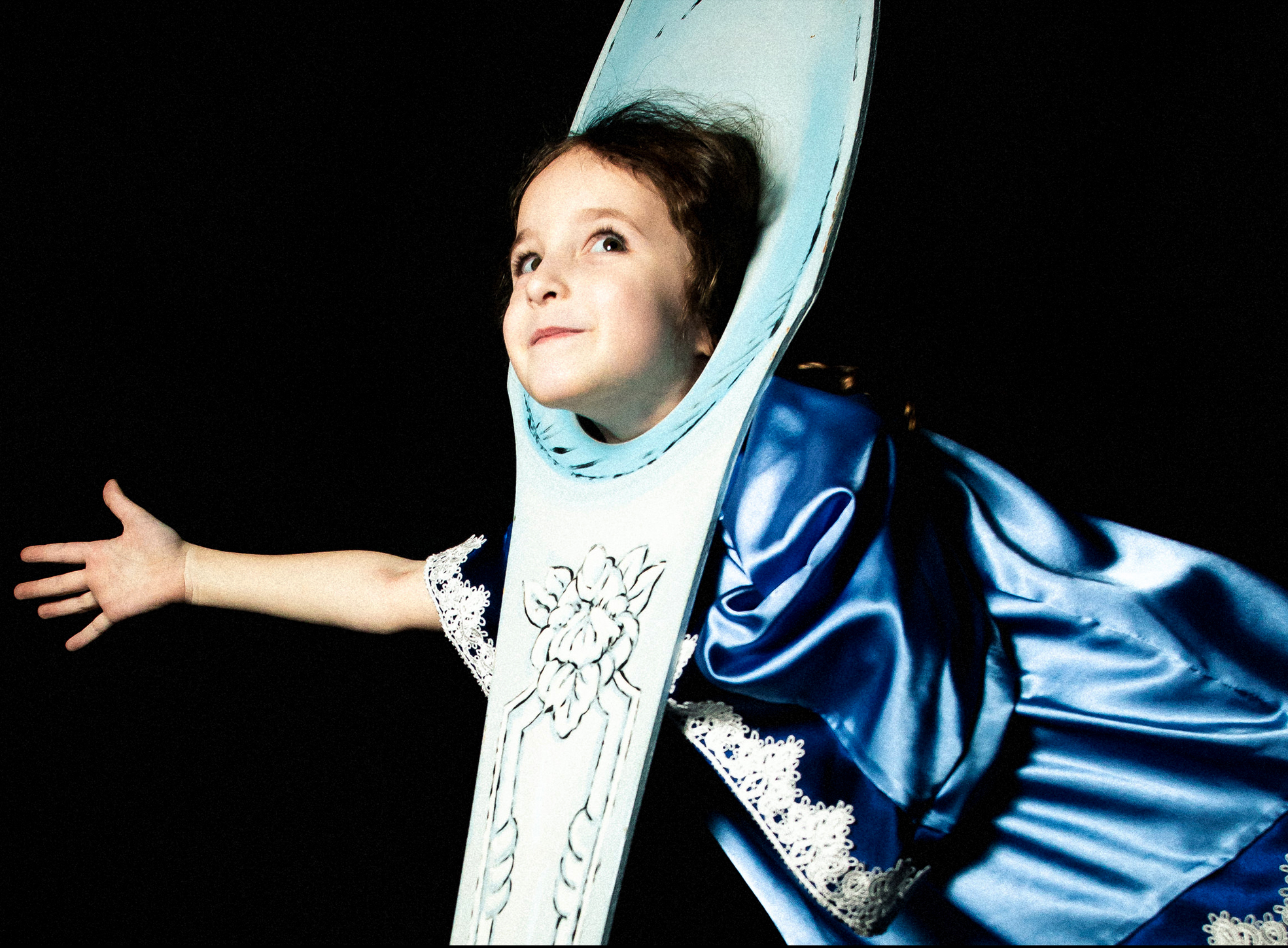
Photograph by Joe Mazza / Brave Lux
Hey Diddle, Diddle: Introduction
Hey Diddle Diddle
Several times in the Cabinet of Wonder series, the phrase “Anything is possible in the Land of Make-Believe” can be heard. Certainly a cat playing the fiddle, a cow jumping over the moon, or a dish running away with a spoon could only happen in our imaginations. Not one bit of the rhyme “Hey Diddle Diddle” makes any sense at all; it’s a delightful piece of “nonsense.” Even the word “Diddle” was made up by Mother Goose when she needed something fun to rhyme with “fiddle.”
Nonsense
Our minds are capable of such fanciful inventions; Mother Goose teaches us that. We can toss all logic aside and delight in the absurd, or just enjoy the sound of words without being burdened by looking for the meaning. Encourage your children to experiment with their own imaginary scenes and characters for more “Hey Diddle Diddle” verses. Maybe the fish swam under the stars or the elephant drove in his car? The horse jumped into the sea or the fox met a bumblebee?
Anthropomorphic
Many characters in children’s books are animals or objects with human characteristics (think of Thomas the Tank Engine, Puss in Boots, Stuart Little, or Peter Rabbit). “Hey Diddle Diddle” is an excellent example of this sort of anthropomorphism. Put together a selection of picture books in your reading corner that feature these sorts of characters this month to pair with “Hey Diddle Diddle.”
The Night Sky
“Hey Diddle Diddle” takes place in and underneath the night sky. We can use this nightscape backdrop for discussing the moon and all things related to outer space (the sun, stars, other planets, meteors, comets, etc.). Earth has one big silver moon and it travels with us on our journey around the sun. Our moon “orbits” around us every 27 days. Ask your children if they have looked in the night sky and noticed how the moon appears to change shape throughout the month. These changes in the shape of the moon are called “phases”: new, crescent, quarter, full. The moon does not create a glow of its own; it reflects the light of our powerful sun.
Why not make a moon journal with your children to keep track of its phases for a month? Children can look at the night sky with their parents and caregivers before bedtime and record the changing shapes they see.
The growing and shrinking of the moon is called the “waxing” and “waning.” Children might be surprised to know that some of the other planets in our solar system have more than one moon. Mars has two, Neptune has 16, Jupiter has 95, and Saturn has 274!
Nocturnal Animals
Many of the characters in the “Hey Diddle, Diddle” nightscape are animals. This could be a chance to talk about the sorts of animals that go about their lives at night. Here are some examples of “nocturnal” animals: racoons, foxes, possums, porcupines, owls, bats, fireflies, panthers, armadillos, and sea turtles. These creatures have stronger senses of smell and hearing than many daylight dwelling animals, and many have eyesight that allows them to see better in the dark.
Fiddle or Violin
The Cat in “Hey Diddle Diddle” earned his fame by playing the fiddle as the Cow jumped over the moon. As we learned while studying the rhyme, “Old King Cole,” “fiddle” is just another word for “violin.” They are the same instrument; “fiddle” is used to describe a violin when it’s playing folk rather than classical music. Ask your children to find the fiddle in the “Hey Diddle Diddle” music video (the violinist is wearing cat ears). The fiddle is the smallest member of the string family, it has four strings and sound holes cut into its top in the shape of lowercase “f’s” (called “f holes”). It can be bowed (arco) or plucked (pizzicatto).
Finger Snapping
The song begins with finger snaps keeping the rhythm. Children find finger snapping very challenging, yet rewarding. This is a great time to try it!
Hey Diddle, Diddle: Discussion
In the Land of Make Believe
Anything is possible in the Land of Make Believe. Can you imagine a cat playing a fiddle, a cow jumping over the moon, or a dish running away with a spoon? This is a nonsense poem, it doesn’t make sense.
Nonsense Rhymes
“Diddle” is a nonsense word that Mother Goose invented when she needed something to rhyme with “fiddle.” Can we think of any nonsense words that rhyme? They don’t need to mean anything. We just want to enjoy the way they sound or feel coming off our tongues. How about, Bobble Nobble, Folly Wolly, Skibble Tibble, Conga Bonga, Jangle Tangle, Veeta Neeta. Let’s go around the circle and have everyone give it a try!
The Fish Swam Under the Moon
Can you think of any other animals or things that might join this “Hey Diddle Diddle” party under the stars? What would they be and what would they be doing? Maybe the fish swam under the stars or the elephant drove in his car? The horse jumped into the sea or the fox met a bumblebee?
Where are they going?
Why are the Dish and the Spoon running away? Where are they going?
The Moon
Our planet is Earth, it has one moon that travels with us on our journey around the sun. It circles around us once every month. Have you ever noticed how the moon changes shape? The different shapes are called “phases”: new, crescent, full. This is called the waxing (growing) and waning (shrinking) of the moon. Let’s each make a moon journal this month! You can look up at the moon every night before you go to bed and draw a picture of what you see. Did you know that Mars has two moons? Neptune has 16 moons and Jupiter has 95! But Saturn has 274 moons!
Nocturnal Animals
The animals in “Hey Diddle Diddle” are all playing at night under the moon. Many animals go about their lives during the night and sleep all day. They are called “nocturnal” animals. Here are some examples of nocturnal animals: racoons, foxes, possums, porcupines, owls, bats, fireflies, panthers, armadillos, and sea turtles. Many nocturnal animals have big ears or eyes to hear and see better in the dark. They might even have a stronger sense of smell.
Hey Diddle, Diddle: Language
KEY RHYMING WORDS
diddle – fiddle
moon – spoon
RELATED RHYMES
middle – riddle – griddle – piddle
soon – croon – loon – noon – swoon – rune – boon – tune – goon – dune
VOCABULARY
“nonsense”
“fiddle”
“violin”
“orbit”
“waxing”
“waning”
“nocturnal animals”
“call and response”
Hey Diddle, Diddle: Activities
OVERVIEW:
In the following activities, children will make a moon calendar, practice snapping their fingers, and explore literature featuring anthropomorphic (human-like animals) characters. They will experiment with call and response game music and game forms and stage their own puppet show!
1. ACTIVITY: A Moon Log
Why not make moon logs with your class? Create small booklets with 27 pages, each page with an empty circle. Your children can watch for the moonrise with their parents before bedtime each night and fill in their moon logs with the changing shapes they see.
2. ACTIVITY: Finger Snapping!
The recording and music video of “Hey Diddle, Diddle” begin with finger snapping. Ask which musicians they can see snapping their fingers in the video. Maybe they would like to give it a try. It may be a challenge to some, but if they master this skill it will be a source of pride.
3. ACTIVITY:
Practice call and response singing with your class through teaching “Hey Diddle Diddle.” After listening to the recording of the song, you will easily pick out the call and response sections. Watch the music video to see the hand gestures that Mother Goose uses to show the cow jumping over the moon. You can incorporate this into your teaching.
4. CRAFT: Making Puppets
Materials:
paper bags of any size
scissors, markers, crayons, glue, popsicle sticks
whatever you have in the classroom to represent the characters (stuffies, figurines, etc.) dress them up with pieces of fabric, etc.
Puppet Characters:
The Cat
The Cow
The Moon
The Dog
The Dish
The Spoon
5. CRAFT: Making a Puppet Theatre:
Materials:
for a shadow puppet theatre:
a projector, or a sheet with a bright light, or a box with white paper and a flashlight
for a paper bag puppet theatre:
a box, or a bench to hide behind
decorate with: paper, stickers, markers, glue, tape.
Teacher: “Today we are going to create a puppet theatre, and puppets to act out the story of ‘Hey Diddle Diddle’.”
6. ACTIVITY: Call and Response with Puppets
Teacher: “We are going to put the music and the characters together. We will perform with one Leader to help us with the call and response.”
Children seated as an audience in front of a stage.
1. Puppeteers take to the stage as Cat, Cow, Moon, Dog, Dish, and Spoon.
2. Leader stands on stage and calls.
3. Audience responds.
4. Actors take bows.
Hey Diddle, Diddle: Music
THE MUSIC
How does this music make you feel?
Is this music slow or fast?
Does it change your mood?
What pictures does this music create in your mind?
Do you imagine a particular place, person, thing, color, animal, etc.?
How would you move to this music?
THE INSTRUMENTS
What instruments do you hear, can you name them?
How do you think the instruments make their sounds?
Are they blown through, plucked, strummed, bowed, tapped, hit, or struck?
Are these instruments made of wood or metal?
Fiddle
The fiddle is another name for a violin that is used in certain genres of music. To play a fiddle/violin you pull a bow made of horsehair across the strings and use your fingers on the other hand to make the strings longer or shorter.
Piano
The piano is a large wooden instrument that produces sound with a system of keys that move small hammers to strike tightly wound metal strings. It is considered part of both the percussion and the string families. The body of the piano is essentially a large wooden box on legs with a flat metal soundboard inside. The thicker (lower) pitched strings are strung on the left side of the soundboard and the thinner (higher) pitched strings on the right. Most pianos have 88 keys: 52 white and 36 black. Upright pianos are smaller than grand pianos but have the same number of keys. All pianos have a lid that can be opened or closed to change the volume.
Drum Set
The instrument that we call a “drum set” or “drum kit” is actually a collection of drums and cymbals set up to be played by one person, rather than a percussion section. The drums are a member of the percussion family. The drummer uses sticks, brushes or mallets in their hands to hit the snare, floor and rack “tom-tom” drums. With one foot, they use a kick pedal to hit the large bass drum, and with the other foot, they push down on another pedal which opens and closes the “hi-hat” cymbals. A drum kit will also include two more cymbals mounted on stands, the large “crash” and smaller “ride” cymbals.
Double Bass
The double bass (sometimes just called bass) is the lowest instrument in the string family. The bass is most often found in classical and jazz music. It can be played by pulling a horsehair bow across the strings or by plucking the strings individually.
GENRE: Jazz-Blues
Jazz-Blues combines elements of soul, R&B, and pop music. Recognized by upbeat and catchy melodies, it often incorporates elements of funk, hip-hop, and jazz.
LESSON 1: Call and Response
Practice call and response singing with “Hey Diddle Diddle.”
LESSON 2: Finger Snapping
Practice finger snapping to “Hey Diddle Diddle” with your children!
LESSON 3: Piano
The piano is a keyboard instrument that produces sound when the black and white “keys” are pushed down. The keys are attached to little felt “ hammers” that strike long metal strings. Have your children identify the piano in the video and talk about how different it is from the brass and clarinet. Notice that some of the keys are black and others are white. If you have access to a piano, open the lid and show them the system of key, hammers, and strings. There are upright and grand pianos. In our video, the musician is playing an upright piano.
Hey Diddle, Diddle: Related Rhymes
“Fiddle Cum Fee” is another Mother Goose rhyme with a fiddling cat.
Fiddle Cum Fee
A cat came fiddling out of a barn,
With a pair of bagpipes under her arm.
She could sing nothing but “fiddle cum fee,”
The mouse has married the bumblebee!
Pipe, the cat!
Dance, the mouse!
We’ll have a wedding at our good house.
“I Had a Little Hen” is a fun anthropomorphic rhyme.
I Had a Little Hen
I had a little hen, the prettiest ever seen,
She washed up the dishes, and kept the house clean.
She went to the mill to fetch me some flour,
She brought it home in less than an hour.
She baked my bread, she brewed my ale,
She sat by the fire and told a fine tale.
“Old Woman Tossed Up in a Basket” is a mysterious Mother Goose rhyme that takes place in the night sky with the moon as its backdrop.
Old Woman Tossed Up in a Basket
There was an old woman tossed up in a basket,
Seven times as high as the moon.
What she did there, I cannot tell you,
But in her hand she carried a broom.
“Old woman, old woman, old woman,” said I,
“Tell me why you fly so high?”
“I sweep the cobwebs from the sky.”
Hey Diddle, Diddle: Standards

Head Start Early Learning Outcomes Framework (ELOF)
Preschool Approaches to Learning 13 | Child uses imagination in play and interactions with others. |
Preschool Scientific Inquiry 2 | Child engages in scientific talk. |
Preschool Scientific Inquiry 3 | Child compares and categorizes observable phenomena. |
Preschool Perceptual, Motor, and Physical Development 3 | Child demonstrates increasing control, strength, and coordination of small muscles. |
Preschool Language and Literacy 5 | Child asks and answers questions about a book that was read aloud. |
The Head Start Early Learning Outcomes Framework: Ages Birth to Five (ELOF) presents five broad areas of early learning, referred to as central domains. The framework is designed to show the continuum of learning for infants, toddlers, and preschoolers. It is grounded in comprehensive research around what young children should know and be able to do during their early years.
The Head Start Program Performance Standards require grantees to implement program and teaching practices that are aligned with the ELOF. Education managers use the ELOF Implementation Toolkit to guide the alignment process and help their programs strengthen practices to promote children’s development in all ELOF domains.
The activities in the Cabinet of Wonder Teaching Guides are in alignment with Head Start’s Early Learning Outcomes Framework (ELOF). They have been designed to enhance any standard preschool curriculum by assisting teachers and families in both meeting school readiness goals and developing a joyful learning journey!