

TEACHING GUIDE 1
Humpty Dumpty sat on a wall.
Humpty Dumpty had a great fall.
All the king’s horses
and all the king’s men
Couldn’t put Humpty together again.
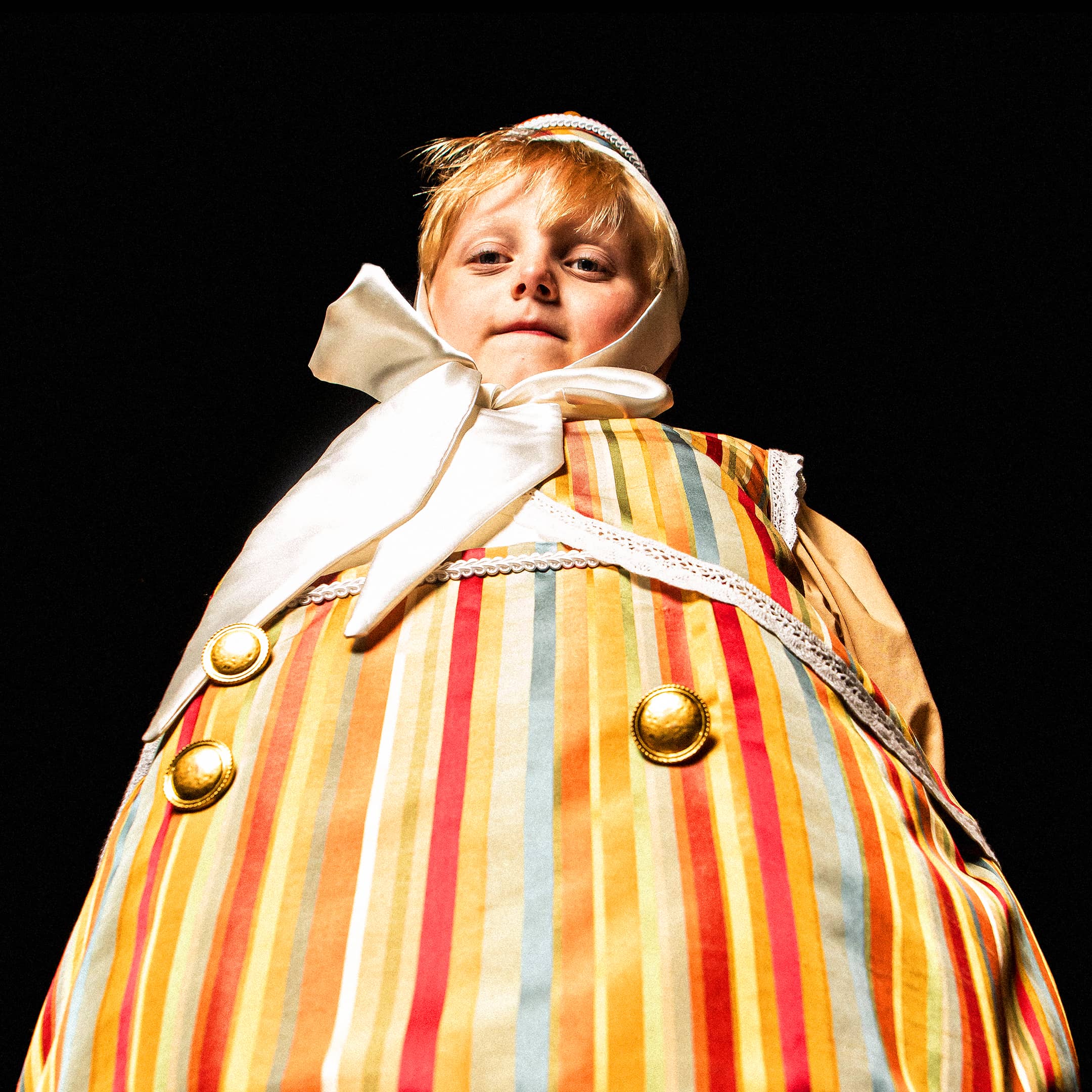
Photograph by Joe Mazza / Brave Lux
Humpty Dumpty: Introduction
Humpty Dumpty
Humpty Dumpty is the first character your children will meet in the Cabinet of Wonder series. They will easily spot him, the carved wooden figure perched on top of Miss Natalie’s cabinet. Humpty is our guardian and gatekeeper of the Land of Make Believe and he invites children to enter with their imagination. Humpty is an enigma, a curious being with a body the shape of an egg, teetering on the top of his wall. The perfect emissary from the world of nonsense, he will puzzle and enchant your children. Throughout the series, we will introduce a parade of characters, but Humpty will stay ever-present, ever watchful.
Nonsense Names
Mother Goose gave Humpty Dumpty a memorable name, as she did with many other characters in her rhymes: Robin the Bobbin, Handy Pandy Jack a Dandy, Mary Quite Contrary, etc. Inventing new nonsense names that rhyme would be a fun game to play with your children. For example: Hoppity Poppity, Lippity Loppity, Nickety Nackity, Huckety Puckety, Stickity Stackity.
Careful or Careless?
Humpty is an egg, and a pretty fragile guy. He needs to be very careful! Did he fall because he was careless? Talk to your children about times they have been careful or careless. Have they ever dropped something that broke? Could they put it back together again? Have they ever fallen down and felt broken? Did someone come to put them back together again?
In Cabinet of Wonder, we’ll always be looking for opportunities to explore language. “Careful” versus “careless” leads to a discussion of opposites: (dangerous – safe), (whole – broken), (thick – thin), (top – bottom). After naming opposites, build vocabulary with synonyms such as fragile, weak, thin, dainty, delicate, flimsy, or strong, sturdy, heavy-duty, indestructible, or broken busted, smashed, snapped, crushed, damaged, in bits and pieces, chipped, wrecked.
All Things Egg
Eggs are fascinating by design, both delicate and strong. Take time to observe and investigate eggs. Let each child hold an egg in the palm of their hand. Experiment: try rolling, floating, and breaking open eggs. Blow out the yolk and pass around the hollow shell. Bring in a variety of eggs; not all eggs are white. Some chickens lay brown, blue, or green eggs. But birds are not the only animals that lay eggs. Many different animals lay eggs in all sizes. A bee’s egg is as tiny as a poppy seed and some dinosaurs laid eggs as big as beach balls! Explain that eggs are where many baby animals of all sorts begin their lives.
Gravity
Humpty’s famous fall introduces another fascinating topic — gravity. Children will be captivated to know there is an invisible force that pulls everything to Earth’s surface. It’s the mass of an object that determines the strength of that pull. You can demonstrate this by showing your children how a scrap of paper falls much more slowly than a wooden block. It’s quite a revelation to learn that Humpty didn’t just fall, he was actually pulled to the ground by gravity!
Pantomimes
Have your children enact the rhyme: taking turns playing Humpty, The King’s Men, and The Horses. Humpty could wear a paper party hat, The King’s Horses might tap the sound of their hooves with wood blocks, and The King’s Men could wear capes. Simple costumes and props will help define the characters and help inspire your actors.
Humpty Games
There are several Humpty Dumpty and egg-themed games your class can play. You’ll find them in the ACTIVITIES section of this guide.
Humpty Dumpty: Discussion
A Rhyming Name
Humpty Dumpty is an interesting name, it rhymes! Mother Goose has lots of characters with names that rhyme. There’s Robin the Bobbin, Handy Pandy Jack a Dandy, Mary Quite Contrary, and more. Do you hear the rhymes? Robbin-Bobbin, Handy-Pandy-Dandy?
Can we invent our own characters with rhyming names? How about Hoppity Poppity, or Lippity Loppity, or Nickety Nackity, or Huckety Puckety, or Stickity Stackity?
A Mysterious Guy
Look at the shape of Humpty’s body, do you think he could be an egg? If he is an egg, should he be sitting so close to the edge of a wall? Shouldn’t he be more careful? Is he being careless?
What does it mean to be “careful” or “careless?” These words mean different things. They are opposites. Here are some more opposites: (up – down), (big – small), (dangerous – safe), (whole – broken), (thick – thin), (top – bottom). Can we think of more opposites?
How about words that mean the same, that are similar? Humpty is fragile, or weak, or thin, or dainty, or delicate, or flimsy.
Some opposites of fragile would be: strong, sturdy, heavy-duty, indestructible, or broken busted, smashed, snapped, crushed, damaged, in bits and pieces, chipped, wrecked.
Falling Down
Have you ever fallen down? Did you feel broken? Did someone come to help put you back together again? You’re not an egg! You can be put back together again.
Putting Things Back Together
Humpty is broken. If you were one of The King’s Men, how would you try to fix Humpty? What would you use? Glue? Tape? String? Gum? Staples?
Eggs
It’s pretty easy to break an egg, the shell is very thin. But eggs are actually pretty strong, in their own way. Let’s look closely at eggs, we can hold them, feel them, roll them, float them, and even break one to see what’s inside. Can you name the parts of the egg (shell, yolk, white).
All sorts of animals lay them: insects, birds, fish, lizards, snakes, turtles, platypuses, and even dinosaurs. Can you imagine how tiny a grasshopper egg is compared to a dinosaur egg? Did you know that eggs are where some baby animals grow? It’s where they start their lives.
Gravity
Gravity is the invisible force that pulls on everyone and everything. On our planet, anything we drop will fall. It was gravity that pulled Humpty to the ground! Luckily, there is gravity everywhere, all the time. If there was no gravity in the universe, everything would just float apart. Imagine that! Nothing could ever be put back together again!
Humpty Dumpty: Language
KEY RHYMING WORDS
humpty – dumpty
wall – fall
RESPONSE RHYMES
tall – ball – call – mall – small – hall – gall – all – squall – shawl – crawl
VOCABULARY
“gravity”
OPPOSITES
Is Humpty careful or careless? Explore other pairs of opposite words.
careful – careless
dangerous – safe
whole – broken
neat – sloppy
big – small
old – new
in – out
loud – quiet
day – night
hard – soft
thick – thin
wide – narrow
top – bottom
SYNONYMS
weak, dainty, fragile, delicate
strong, sturdy, heavy-duty
broken, busted, smashed, snapped, crushed, damaged, chipped, wrecked
Humpty Dumpty: Activities
OVERVIEW
In the activities and games below, children will experiment with eggs and play numerous egg-themed games. They will invent nonsense names, dance in a conga line, learn to play rhythms with shakers, and practice skipping and galloping like horses. While performing a pantomime, they’ll take turns playing the roles of Humpty, The King’s Men, and The Horses.
1. GAME: Egg Hunt
Stage an egg hunt in your room using plastic Easter eggs. There could be prizes inside or paper slips with clues to other hidden objects. Another idea could be to write single words on folded papers that need to be put back together again – Humpty style!
2. GAME: Egg & Spoon Relay
Materials:
spoon
real egg or plastic egg or percussion shaker egg
Taking inspiration from traditional Easter eggs games, children pass an egg from spoon to spoon around their circle (a plastic egg, if you wish to avoid a mess). Percussion shaker eggs have the perfect weight. Have your children recite the rhyme during the relay, slowly or quickly. The child who starts each round is responsible for choosing the speed!
3. ACTIVITY: Humpty Puzzles
Unlike Humpty, puzzles can be broken into pieces and put back together again. Maybe your class could make a big drawing of Humpty Dumpty and then divide him into pieces to make a puzzle.
4. GAME: Humpty, Where’s Your Wall?
Materials:
a blindfold
paper or cloth backdrop with painting of a wall
tape or velcro
Play a modified game of Pin the Tail on the Donkey called “Humpty, Where’s Your Wall?” One child, who is blindfolded, tries to place a Humpty figure at the top of a paper wall or backdrop. “Pin” the Humpty figure to the wall with tape, velcro, etc.
5. DANCE: Make a Conga Line!
This song has echoes of the Caribbean islands with similarities to Calypso from Trinidad and Tobago and “cha-cha-cha” rhythms from Cuba. Have some fun and form a conga line (like the children in the music video) and dance through your classroom or out the door to recess!
6. ACTIVITY: Humpty Pantomime
Materials:
paper party hat
woodblocks or rhythm sticks
capes
Have your children enact the rhyme and take turns playing Humpty, The King’s Men and The Horses. Provide simple costume pieces and props. Humpty can wear a paper party hat, The King’s horses can tap the sound of their hooves with wood blocks and The King’s men can wear capes.
7. GAME: Circle Ribbon Game
Materials:
a wide satin ribbon
paper party hat Take a wide satin ribbon, tie the two ends together, and have your children hold it in a wide circle. The ribbon will give them a tangible connection to each other and a sense of the circle’s shape and limits. Each child can have a turn wearing the paper party hat and playing Humpty in the center of the circle. For extra fun, raise and lower the ribbon on cue.
Humpty Dumpty: Music
THE MUSIC
How does this music make you feel?
Is this music slow or fast?
Does it change your mood?
What pictures does this music create in your mind?
Do you imagine a particular place, person, thing, color, animal, etc.?
How would you move to this music?
How would you move your hand in the air if you were conducting this song?
THE INSTRUMENTS
What musical instruments do you hear, can you name them?
How do you think the musical instruments make their sounds?
Are they blown through, plucked, strummed, bowed, tapped, hit, or struck?
What instrument families do these instruments belong to?
Are these instruments made of wood or metal?
Does this musical instrument play high or low pitches?
Marimba
The marimba is a percussion instrument with wooden bars that the player strikes with a soft yarn mallet. Below each bar is a metal pipe that helps produce the sound. The marimba is similar to a xylophone but is larger and has a lower range.
Flute
The flute is a member of the woodwind family, even though it is typically made of metal. To make a sound on the instrument you blow air across an open hole. The air vibrates to create the sound. The flute is one of the oldest instruments. Most cultures around the world have their own version of the flute.
Violin
The violin (also known as the fiddle) is the smallest and highest pitched instrument in the string family. The violin has four strings and is played by pulling a bow made of horsehair across the strings, which causes them to vibrate.
Viola
The viola is a member of the string family that is slightly larger than the violin and therefore plays slightly lower notes. The viola is typically thought of as the alto voice of the string section. A viola has four strings and is played in the same manner as the violin, by pulling a horse hair bow across the strings.
Cello
The cello is a member of the string family that is typically considered the tenor voice of the section. The cello has four strings that vibrate by pulling a bow made of horsehair across them. A cellist must be seated with the instrument held in front of them to be played correctly.
GENRE: Calypso
Calypso is a vibrant style of Caribbean music that originated in Trinidad and Tobago. Calypso music features percussion focused tricky rhythms with heavy syncopation.
LESSON 1: The Marimba
Marimba is the featured instrument in the “Humpty Dumpty” recording. The music video begins with the impressive marimba filling the entire screen. The musician is hitting the wooden tone bars with a pair of mallets (made of a rubber or wooden ball wrapped in yarn or string).
LESSON 2: Pizzicato
Classical musicians all over the world use a standard musical language of Italian words to communicate. Italy was the first country in Europe to use common terms to describe music centuries ago and their system was universally adopted. You may have heard some of these terms: “tempo” (speed), “piano” (soft and quiet), “forte” (strong and loud), “ritardando” (slowing), “allegro” (quick and lively).
String instruments can be bowed or plucked to make their sound. In the arrangement of “Humpty Dumpty,” they do both. In Italian, “pizzicatto” means “plucked” and “arco” means “bow.”Listen with your children to the sound of the string quartet. Notice when they are playing “arco” with their bows or “pizzicatto” with their finger tips.
Calypso is a vibrant style of Caribbean music that originated in Trinidad and Tobago. Calypso music features percussion focused tricky rhythms with heavy syncopation.
Humpty Dumpty: Related Rhymes
“Jack-A-Dandy” is another Mother Goose character with a rhyming name.
Jack-A-Dandy
Handy Pandy, Jack-a-Dandy,
Loves plum cake and sugar candy.
He bought some at a grocer’s shop,
And out he came hop, hop, hop!
“Robbin the Bobbin” is a very eccentric Mother Goose character.
Robbin the Bobbin
Robin the Bobbin, the big bouncing ben,
He ate more meat than fourscore men.
He ate a cow, he ate a calf,
He ate a butcher and a half,
He ate a church,
He ate a steeple,
He ate the town and all the people!
Humpty Dumpty: Standards
Head Start Early Learning Outcomes Framework (ELOF)
Preschool Social and Emotional Development 6 | Child expresses a broad range of emotions and recognizes these emotions in self and others. |
Preschool Mathematics Development 9 | Child identifies, describes, compares, and composes shapes. |
Preschool Language and Communication 7 | Child shows understanding of word categories and relationships among words. |
Preschool Perceptual, Motor, and Physical Development 3 | Child demonstrates increasing control, strength, and coordination of small muscles. |
Preschool Scientific Inquiry 1 | Child observes and describes observable phenomena (objects, materials, organisms, and events). |
The Head Start Early Learning Outcomes Framework: Ages Birth to Five (ELOF) presents five broad areas of early learning, referred to as central domains. The framework is designed to show the continuum of learning for infants, toddlers, and preschoolers. It is grounded in comprehensive research around what young children should know and be able to do during their early years.
The Head Start Program Performance Standards require grantees to implement program and teaching practices that are aligned with the ELOF. Education managers use the ELOF Implementation Toolkit to guide the alignment process and help their programs strengthen practices to promote children’s development in all ELOF domains.
The Cabinet of Wonder teaching guides are in alignment with Head Start’s ELOF. They have been designed to enhance any standard preschool curriculum by assisting teachers and families in both meeting school readiness goals and developing a joyful learning journey!