

TEACHING GUIDE 5
I had a little nut tree,
Nothing would it bear
But a silver nutmeg
And a golden pear.
The king of Spain’s daughter
Came to visit me
And all for the sake
Of my little nut tree.
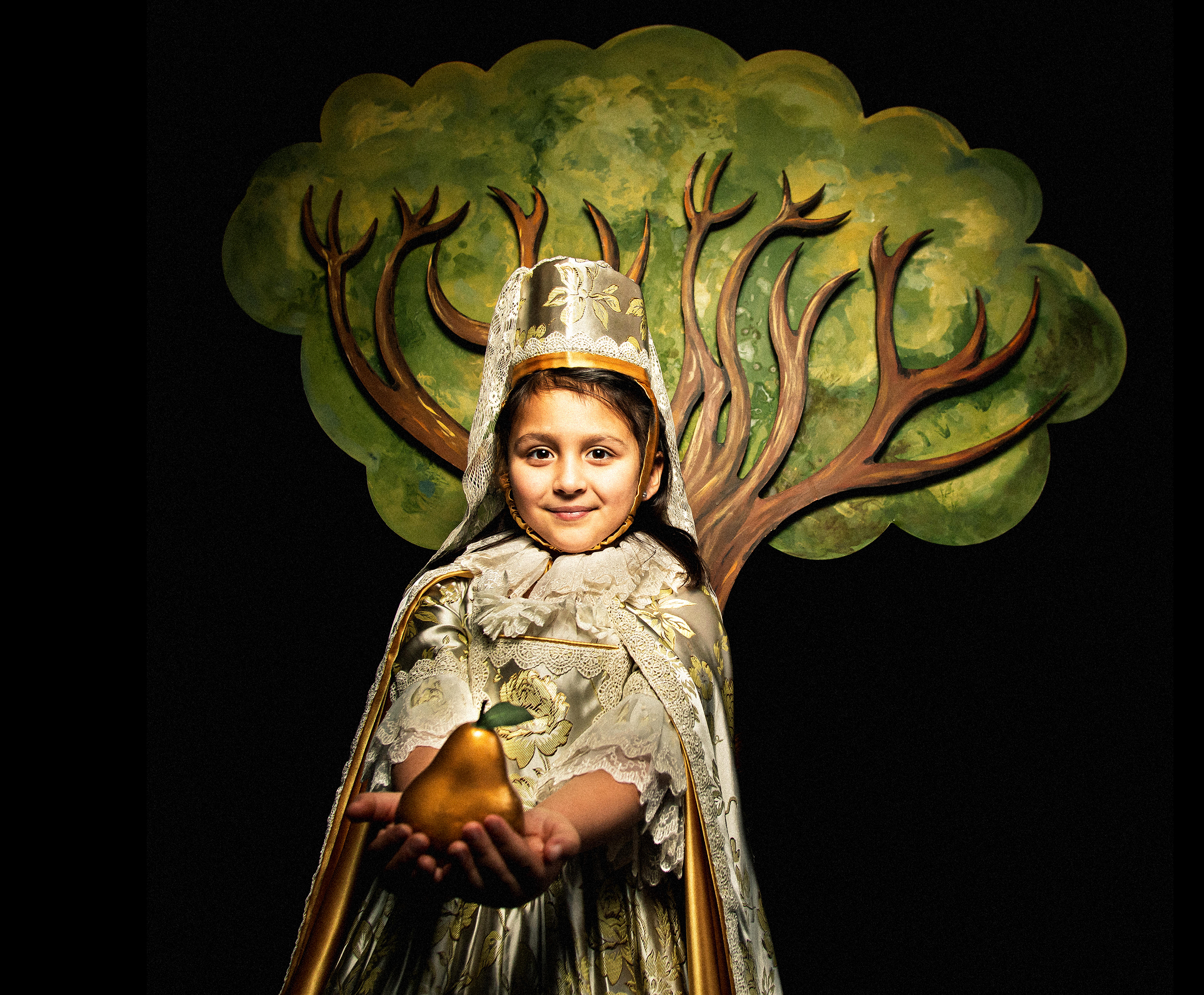
Photograph by Joe Mazza / Brave Lux
Little Nut Tree: Introduction
Little Nut Tree
The story of “Little Nut Tree” takes place in the Land of Make Believe, but this rhyme can open the door to explorations of real and far-off lands. The King of Spain’s daughter has traveled far to see the little boy’s magic tree. So, where in the world is Spain? What language is spoken by the people of Spain? What are their customs? Is there still a Spanish royal family? These would all be good departure points.
Orchards and Fruiting Trees
The little boy’s magic pear tree grows in an orchard or grove (a garden of fruiting trees). Some other fruit bearing trees are: apple, cherry, peach, plum, orange, lemon, apricot, mango, guava, fig, papaya, and coconut. Some fruits grow on trees while others grow on vines, such as: grapes, passionfruit, kiwi, dragon fruit, and melons. And fruit also grows on bushes (blackberries, blueberries, raspberries, strawberries). We call these other growing places “vineyards” and “patches.”
Many berry patches are thorny. If children have ever picked raspberries or blackberries, they’ve encountered thorns or “prickers” (from the word “prick”). Explain that plants grow thorns to protect themselves from being eaten. This allows their seeds to grow large and make more berry plants.
When Spices Were Treasure
The boy’s magic tree also grows a silver nutmeg. It may cause confusion to learn that nutmeg is not actually a nut at all. It is the kernel, or seed of a fleshy yellow fruit native to Indonesia. Introduce your children to a real nutmeg and its fragrant mesh of outer tissue that we call “mace.” People once took great risks and travelled long distances to obtain spices; they were considered as precious as gold.
Something Spicy
Spices are very fragrant and have interesting shapes to fascinate your children (nutmeg, mace, cinnamon, clove, star anise, cardamom, ginger, pepper). Your little botanists can explore the spices in their own pantries at home and share them with the class. This might naturally lead to a discussion about varied foodway traditions.
The word “spicy” is derived from “spice.” Think of other similar words: zesty, tasty, hot, peppery, picante, strong. The opposite of “spicy” would be “bland.” Ask your children if they have ever tasted something spicy, and how it felt on their tongues. Did it burn or sting? Did it give them a tummy ache? Maybe they enjoyed it. The foods we eat tend to be sweet, sour, salty, bitter, and savory. Children can take turns telling the class their favorite flavors.
All Our Senses
We experience the marvel of spices through four of our five senses: sight, touch, smell, and taste. Add “hearing” to the list and talk about all the ways we use our five senses to know and recognise our surroundings. Some people are born without one or more of their senses and learn to use their other senses in new ways to compensate for that loss. People born without the sense of sight can read with their fingertips by feeling rows of raised bumps called “braille.” People born without the sense of hearing use their eyes to read lips and speak with their hands using sign language.
Bows and Curtsies
In acting out the story of “Little Nut Tree” children can practice the act of giving and receiving with elegant “bows” and “curtsies”. Have the entire class recite the rhyme while two child actors pantomime gifting and receiving the golden pair. A third child can join to play the role of the attendant (as in the videos).
To Bear
There are two key idioms in this rhyme: “nothing would it bear” and “all for the sake of.” In the context of this rhyme, “to bear” means “to grow,” and in this case, grow fruit. But “to bear” can also mean “to carry” (like a burden or a child). “For the sake of” means ”for the purpose or benefit of” or “something that happened or exists.” Other idioms that use “sake” are: “for goodness’ sake” and “for heaven’s sake.” The word can be used in a sentence like: “I gave up my seat on the bus for her sake.”
La Mantilla
Notice the unusual crown that the princess is wearing in the photographs and music video. This is a traditional Spanish headdress called a “mantilla” (pronounced man-tee-yah) made of lace pulled over a large decorative comb called a “peineta” (pronounced: pay-net-uh).
Una Pera de Oro
Miss Natalie briefly speaks to the princess in Spanish at the end of the teaching video, “¡Que tan maravillosa es esta pera de oro!” (How marvelous is this golden pear)! Teach some basic Spanish words or phrases to your class (una pera, oro, la princesa, bienvenido, gracias). Add these phrases to your playacting. There may be bilingual children in your class who can help!
Little Nut Tree: Discussion
A Magic Pear
There is a magic golden pear that grows from a tree in the Land of Make-Believe. Have you ever seen fruit growing from a tree? What fruit was it? Where were you? Have you ever gone apple, cherry, or peach picking?
Where Fruit Grows
The place where fruit trees grow is called an orchard or a grove (apple, cherry, peach, plum, orange, lemon, apricot, mango, guava, fig, papaya, and coconut). Some fruits grow on vines in vineyards (grapes, kiwis, dragon and passion fruits). Some fruits grow on bushes (blackberries, blueberries, raspberries, strawberries). We call the places where berries and melons grow “patches.” Some berry bushes have protective thorns. Can you guess why?
When Spices Were Treasure
Nutmeg is not actually a nut at all! It is the large seed inside a fleshy yellow fruit (like apricots). It comes from an island in Indonesia that people once called the “Spice Islands.” Long ago spices were as precious as gold.
Something Spicy Have you ever smelled or tasted spices (nutmeg, mace, cinnamon, clove, star anise, cardamom, ginger, pepper)? Can you look in your spice cabinet at home and find some to share with our class? What are some of your favorite dishes that your family eats? What spices are in them? Have you ever tasted something spicy? How did it feel on your tongue? Did it burn or sting? Did it give you a tummy ache? Did you like it?
Giving and Receiving
In “The Little Nut Tree” the boy gives his precious golden pear to the princess. Let’s act out the rhyme and practice giving and receiving. Would you like to practice our bows and curtsies?
All Our Senses
We have five senses: sight, touch, smell, taste, and hearing. We use all our senses to know the world around us. Some people are born without one or more of their senses. Imagine you had to recognize the world through your fingertips? People without the sense of sight read by feeling rows of raised bumps called “braille.” And people without the sense of hearing can read lips and use sign language.
“La Mantilla” The Spanish Princess in the music video wears a traditional Spanish headdress made of lace called a “mantilla” (pronounced man-tee-yah).
“Una Pera de Oro”
In the video, Miss Natalie briefly speaks in Spanish. “Que tan maravillosa es esta pera de oro!” (How marvelous is this golden pear)! Let’s learn some more words that the Spanish princess will understand.
bienvenido (welcome)
por favor (please)
gracias (thank you)
un regalo (a gift)
una pera de oro (a golden pear)
la princesa (the princess)
un árbol (a tree)
Little Nut Tree: Language
KEY RHYMING WORDS
bear – pear
me – tree
RESPONSE RHYMING WORDS
hair – chair – tear – flair – rare – stair – mare – care – fair – glare
bee – knee – glee – free – he – pea – tea – plea – three – see – me – we
IDIOMS
“nothing would it bear”
“for the sake of”
VOCABULARY
“bow” “curtsey”
“orchard”
“vineyard”
“berry patch”
“nutmeg”
“prickers”
“spice”
“spicy”
“taste bud”
“braille”
“mantilla”
“Peineta”
Little Nut Tree: Activities
OVERVIEW
In the following activities, children will associate music with color, explore spices, work as a team in a relay, gently lull a baby to sleep, practice giving and receiving gifts, and learn a few words and phrases in Spanish.
1. ACTIVITY: Color the Song
Materials:
crayons and paper
Teacher: “We’re going to listen to the song and I want you to think about what color it makes you think of and what picture it puts in your head.”
Seat at tables.
1. Give each child sitting at the table a piece of paper.
2. Play the “Little Nut Tree” song.
3. After the song ends, offer a selection of crayons to the children. Ask them to pick the color that came to mind while they were listening.
4. Have the children draw what the music sounded like to them.
3. Play the song several times to inspire the children while they are drawing.
2. GAME: Pass the Pear
Materials:
pear (real, artificial or whatever fruit you have)
Teacher: “We are going to play ‘Pass the Pear.’ For this game, we will be an “ensemble” (a group of people working together). We have to work together to pass the golden pear around our circle.”
Standing or seated in a circle.
1. Play the song “Little Nut Tree.”
2. Have your children pass the golden pear around the circle, be careful not to drop it!
3. If they drop it, take a deep breath and start again.
4. Repeat.
5. Celebrate working as an ensemble at the end.
3. GAME: Lullaby Baby
Materials:
a toy or stuffed animal to be the “baby”
Teacher:
“We’re going to play a game called ‘Lullaby Baby.’ ‘Little Nut Tree’ is a beautiful lullaby.” Do you know what lullabies do? We sing them to help put our babies to sleep. Can you show me what it looks like to rock a baby to sleep? Do you think a lullaby should be loud and fast or soft and quiet?”
Seated in a circle.
1. Ask your children to find a “baby” and bring it with them into the seated circle.
2. Play the song “Little Nut Tree.”
3. Have your children gently rock their babies to sleep along with the music.
4. GAME: The Giving Game
Materials:
pear (real, artificial, or whatever fruit you have)
Teacher: “We’re going to play a game called ‘The Giving Game.’ In ‘Little Nut Tree’ the little boy gives the princess from Spain a golden pear as a gift. Have you ever given a gift? Have you ever received a gift? What do you say when you receive a gift?”
Standing or sitting in a circle.
1. Play the instrumental version of the “Little Nut Tree” to guide the choreography of the game.
2. Teacher: model a curtsy and a bow and explain that this is a way of showing respect and gratitude to others.
3. Select the first pair to stand in the center of the circle (Child 1 is the Giver and holds the pear. Child 2 is the Receiver).
4. The Giver and the Receiver face each other.
5. The Giver bows or curtseys and says, “This is a gift for you.”
6. The Receiver says, “Thank you,” and bows in return.
7. The Receiver then hands the pear to the next child in the circle and sits down.
8. The new Giver begins the ritual again as the old Giver becomes receiver.
9. Go around the circle until everyone has both given and received the pear.
VARIANT: Gifting at Random
Rather than taking turns by moving in order around the circle, any child in the circle can be chosen at random.
VARIANT: Gifting with Emotions
Children respond to receiving the pear with: surprise, happiness, shyness, joy, etc.
VARIANT: Gifting in Spanish
The dialogue in the giving game could be in Spanish:
“¡Que tan maravillosa es esta pera de oro!” (how marvelous is this golden pear)!
un regalo para it (a gift for you)
how marvelous, thank you (que maravillosa, gracias)
bienvenido (welcome)
por favor (please)
gracias (thank you)
una pera de oro (a golden pear)
la princesa (the princess)
un árbol (a tree)
5. ACTIVITY: Something Spicy
Explore the shapes, colors, scents, textures, and flavors of spices with your children (nutmeg, mace, cinnamon, clove, star anise, cardamom, ginger, pepper, and others). Some might be familiar, but many will be first time encounters. Where do they grow in the world? What part of the spice plants do we use (leaves, bark, roots, seeds)? How are they prepared? Do we eat them whole or are they crushed into a powder? Are they sweet or hot?
Little Nut Tree: Music
THE MUSIC
How does this music make you feel?
Is this music slow or fast?
Does it change your mood?
What pictures does this music create in your mind?
Do you imagine a particular place, person, thing, color, animal, etc.?
How would you move to this music?
THE INSTRUMENTS
What instruments do you hear, can you name them?
How do you think the instruments make their sounds?
Are they blown through, plucked, strummed, bowed, tapped, hit, or struck?
Are these instruments made of wood or metal?
Harp
The harp is a large stringed instrument with 47 strings and 7 pedals. The instrument is played by plucking the strings while the pitch is adjusted with the pedals. There are many versions of the modern harp in cultures around the world and throughout history.
GENRE: Chamber Music
Chamber music is a form of classical music performed by a small group of instruments, traditionally in a close setting with a limited audience. A chamber ensemble typically only has one person on each part and the focus is on balance rather than large sound effects.
Flute
The flute is a member of the woodwind family, even though it is typically made of metal. To make a sound on the instrument you blow air across an open hole, the air vibrates to create the sound. The flute is one of the oldest instruments with most cultures around the world having their own version of a flute.
The flute is also very present in the arrangement of “Little Nut Tree.” The flute is a member of the woodwind family. We know that people have been making and playing flutes for 40,000 years. Flutes were once made of wood, reeds, bone and ivory (even glass) but modern flutes are made of metal (silver, nickel, brass, gold, platinum). A standard concert flute is 26 inches long and has 16 sound holes. The “flautist” or flute player makes sound by blowing air downward into a small hole at the “crown” of the flute’s hollow tube, and changes pitch by covering and uncovering the keys over the sound holes.
Violin
The violin (also known as the fiddle) is the smallest and highest pitched instrument in the string family. The violin has 5 strings and is played by pulling a bow made of horsehair across the strings to cause them to vibrate.
Viola
The viola is a member of the string family that is slightly larger than the violin and therefore plays slightly lower notes. The viola is typically thought of as the alto voice of the string section. A viola has 4 strings and is played in the same manner as the violin, by pulling a horse hair bow across the strings.
Cello
The cello is a member of the string family that is typically considered the tenor voice of the section. The cello has four strings that vibrate by pulling a bow made of horsehair across them. A cellist must be seated with the instrument out in front of them to be played correctly.
LESSON 1: The Harp
“Little Nut Tree” is the only music video in which the harp is seen (it is heard in the opening song, “Cabinet of Wonder”). The harp is a magnificent instrument that will certainly fascinate your children. The harp is in the string family and its sound is made by fingertips plucking its strings by a harpist.
The harp is one of the oldest instruments, the earliest evidence of them comes from paintings and sculpture in Egypt 5000 years ago. These harps were much smaller and had far fewer strings. Harps are made in many different sizes. Some harps are small enough to hold on your lap but the concert harp that you will see and hear in an orchestra is large.
A modern concert harp has 47 strings and seven pedals. The harp is shaped like a triangle. Harp strings are different colors to help the musician find the right notes: C strings are red, F strings are black or blue and the other strings are white. The strings of a harp are wound around tuning pins in its frame. The harpist leans this big instrument against their right shoulder to play and uses all their fingers to pluck except their pinky fingers (they are too short and weak). The 7 pedals pull and release the strings to change their pitch. There is one pedal for each set of notes in the diatonic scale (C, D, E, F, G, A, B). The “soundbox” or body of the harp is hollow and acts as a resonator, amplifying the sound of the vibrating strings.
LESSON 2: What is a String Quartet?
“Little Nut Tree” is the only song in our series that shows a string quartet playing together. “Quartet” means four people. A string quartet is made up of two violins, a viola, and a cello. Children will notice the size range in these string family instruments. Although the cello is much larger than the violin and viola, there is still another larger four-stringed instrument in the orchestra, the double bass.
Little Nut Tree: Related Rhymes
A magical nutmeg grove and another king’s daughter are featured in the Mother Goose rhyme “The King of China’s Daughter.”
The King of China’s Daughter
The King of China’s daughter,
So beautiful to see,
With her face like yellow water,
Left her nutmeg tree.
Her little rope for skipping
She kissed and gave it me,
Made of painted notes of singing-birds
Among the fields of tea.
I skipped across the nutmeg grove,
I skipped across the sea,
But neither sun nor moon, my dear,
Has yet caught me.
“Mistress Mary” has a magical garden of silver flowers, shells and pretty maids.
Mistress Mary
Mistress Mary, quite contrary,
How does your garden grow?
With silver bells and cockleshells,
And pretty maids all in a row.
Little Nut Tree: Standards

Head Start Early Learning Outcomes Framework (ELOF)
Preschool Approaches to Learning 11 | Child shows interest in and curiosity about the world around them. |
Preschool Scientific Inquiry 3 | Child compares and categorizes observable phenomena. |
Preschool Language and Literacy 7 | Child shows understanding of word categories and relationships among words. |
Preschool Scientific Inquiry 1 | Child observes and describes observable phenomena (objects, materials, organisms, and events). |
Preschool Approaches to Learning 13 | Child uses imagination in play and interactions with others. |
Preschool Language and Literacy 5 | Child asks and answers questions about a book that was read aloud. |
The Head Start Early Learning Outcomes Framework: Ages Birth to Five (ELOF) presents five broad areas of early learning, referred to as central domains. The framework is designed to show the continuum of learning for infants, toddlers, and preschoolers. It is grounded in comprehensive research around what young children should know and be able to do during their early years.
The Head Start Program Performance Standards require grantees to implement program and teaching practices that are aligned with the ELOF. Education managers use the ELOF Implementation Toolkit to guide the alignment process and help their programs strengthen practices to promote children’s development in all ELOF domains.
The Cabinet of Wonder teaching guides are in alignment with Head Start’s ELOF. They have been designed to enhance any standard preschool curriculum by assisting teachers and families in both meeting school readiness goals and developing a joyful learning journey!