

TEACHING GUIDE 4
Old King Cole was a merry old soul,
And a merry old soul was he.
He called on his pipe
and he called on his bowl,
And he called on his fiddlers three.
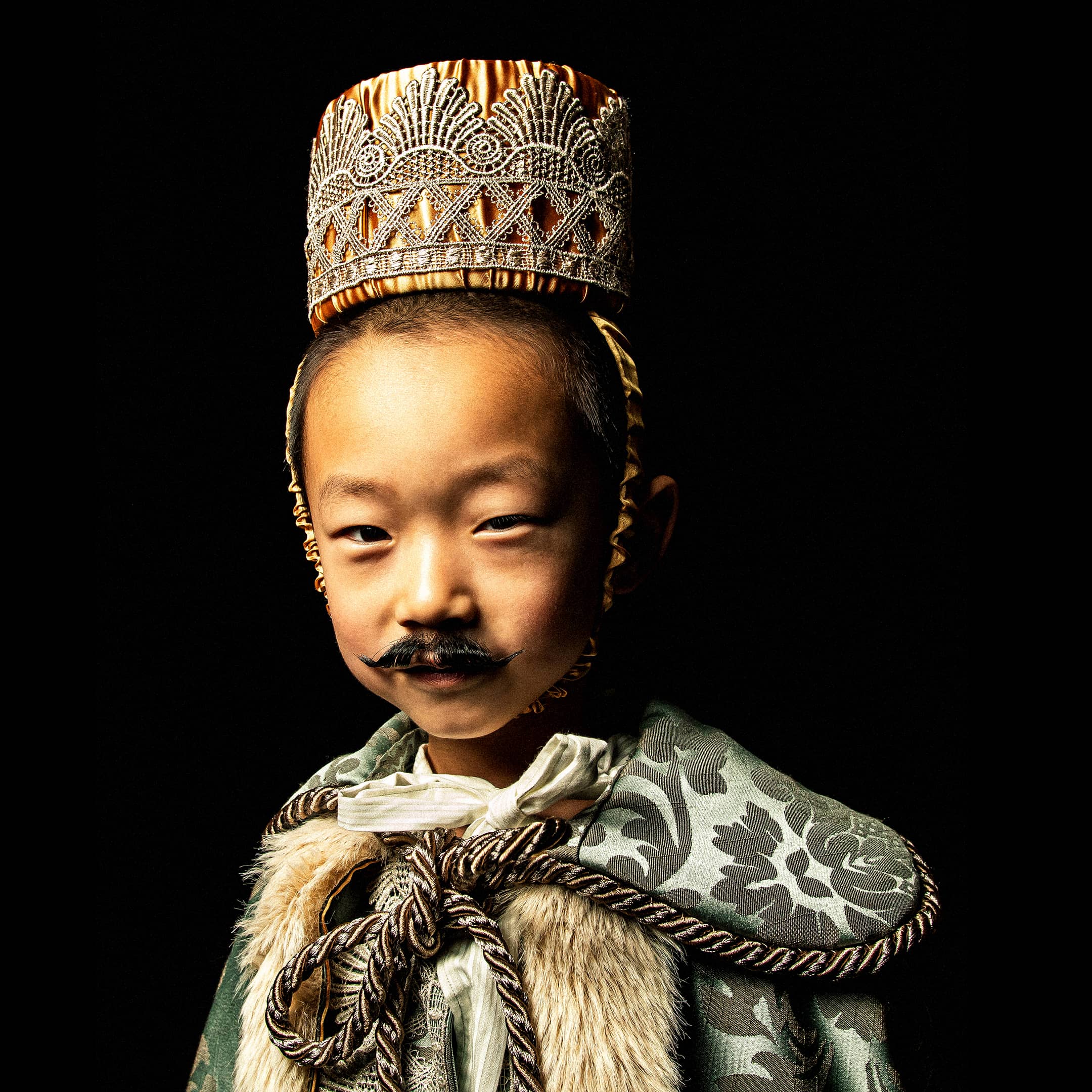
Photograph by Joe Mazza / Brave Lux
Old King Cole: Introduction
Old King Cole
Old King Cole is a popular Mother Goose character, known for his jolly disposition, and love of feasting and fiddle music. In the music video, we see him in his castle seated on his red velvet throne, surrounded by his entire court. He wears a crown of gold and a cape of silk brocade trimmed in fur and in his hand he holds a gem-studded sceptre. When he enters a room, trumpets play fanfare and everyone bows low or curtsies to show their respect. This rhyme’s theme of royalty allows children to practice elegant and refined manners.
Royal Families
In some countries there are still royal families that have ruled through generations (although their power has diminished). England, where Mother Goose was born, has had a King or Queen on its throne for over ten centuries. However, in the United States there is no king; the people elect a President every four years. That is an important point to make to American children: they live in a democracy, not a monarchy.
Being Royal
When chanting this rhyme together, have your children stand, hands on hips with perfect posture. Watch the series of gestures Mother Goose makes in the music video, first cupping her right hand to the side of her mouth to say, “He called for his pipe,” then changing to the opposite side to say, “He called for his bowl.” Have your children do the same. They can finish the phrase by holding up either hand to count out, “One, two, three.”
The Famous Fiddlers Three
The word “fiddle” is interchangeable with the word “violin.” They both describe the smallest member of the string family. People tend to use the word fiddle when referring to folk music and violin for classical, but they are the same instrument. A person who plays a fiddle is a “fiddler.” Ask your children to find the famous fiddlers three in the video.
Child-Sized Instruments
If possible, give your children the chance to hold a child-size violin, to pluck and bow its strings. Try the same with toy trumpets; holding one will make a big impression.
Fanfare
The two children at the top of the music video are pretending to play “fanfare” on their toy trumpets. Fanfare is a burst of music played to announce the arrival of an important person. Ask your children to find the adult musicians who are playing fanfare on real instruments (trumpet, trombone, French horn and tuba).
Merry, Marry, and Mary
There are a few key vocabulary words in the rhyme for young children: “soul,” “fiddle,” and “merry.” “Merry” has many synonyms (happy, glad, cheerful, joyful, jolly, spirited). Most children will be familiar with the greeting “Merry Christmas!” In English we have many words that have the same sound, but entirely different meanings. The word “merry” describes “cheerful” and can also be heard as the verb “to marry” and the female name “Mary.”
Make a game of finding other homophones. Some examples are: sun – son, sea – see, be – bee, know – no, flower – flour, dear – deer, hour – our, sail – sale, hear – here, blue – blew, ate – eight, week – weak, witch – which, wood – would, through – threw.
Windows of the Soul
“Soul” is a nuanced word that may be difficult to define for children. It cannot be seen; it’s invisible. A soul is the spirit and life force of a living thing. We have many beautiful expressions concerning the soul. A person we feel a deep connection with is a “soulmate.” Someone who is wise beyond their years is called an “old soul.” And we often say that “the eyes are the windows of the soul.” A discussion with your children about this simple word will have great depth and meaning.
Old King Cole: Discussion
Kings and Queens
This rhyme is about a king and in the video we see him on his throne with his royal court. In England (where Mother Goose was born), they still have a king and queen. A king or queen rules for a lifetime. This is called a “monarchy.” In the United States of America, there is no royal family, the people elect a President every four years. This is called a “democracy.”
A Merry Old Soul
Old King Cole was a “merry” old soul. What does “merry” mean? (happy, glad, cheerful, joyful, jolly, spirited). Have you ever heard people say, “Merry Christmas?”
If you spell this word with an “a” instead of an “e,” it still sounds the same but means something different. It becomes “marry” (a ceremony where people promise to live and love each other for the rest of their lives).
Now take away one of the “r’s” in “marry” and we have a name instead. Do you know anyone named “Mary”?
All these words all sound the same but mean very different things! They are called hom-o-phones.
The sun is warm today.
My son is at school.
I can’t see the boat.
The boat is on the sea.
I want to be in the garden.
The bee is making honey.
She looked through the window.
She threw the ball.
Can we think of any other homophones? (know – no, flower – flour, dear – deer, hour – our, sail – sale, hear – here, blue – blew, ate – eight, week – weak, witch – which, wood – would).
Windows of the Soul
Old King Cole is a merry old “soul.” A “soul” is an invisible thing but we often talk about it. We call our close friends “soulmates” and very wise people are “old souls.” Have you ever heard anyone say, “I won’t tell a soul” or “the eyes are the windows of the soul”? What is a soul?
Fiddles and Violins
“Violin” and “fiddle” are both names for the smallest instrument in the string family. A person who plays a fiddle is a “fiddler.” The fiddle or violin is made of wood and is hollow inside. It has four strings that you can pluck or bow to make sound. Can you find the fiddlers three in the music video?
Old King Cole: Language
KEY RHYMING WORDS
Cole – soul – bowl
he – three
RESPONSE RHYMES
toll – roll – pole – mole – hole – droll – goal – scroll – whole
be – knee – tree – free – me – we – tree – key – tea – plea – flea – glee – sea – see
VOCABULARY
“merry”
“soul”
“royal”
“monarchy”
“democracy”
“fiddle”
“fiddler”
“fiddling”
“fanfare”
IDIOMS
“the eyes are the window of the soul”
“soulmate”
“old soul”
“I won’t tell a soul”
SYNONYMS
merry, happy, glad, cheerful, joyful, jolly, spirited
HOMOPHONES
merry – marry – Mary
sun – son
sea – see
know – no
flower – flour
dear – deer
hour – our
sail – sale
hear – here
blue – blew
ate – eight
week – weak
witch – which
wood – would
through – threw
Old King Cole: Activities
OVERVIEW
In the following activities, children will synchronize gestures with music, make paper instruments, play musical freeze, learn about fanfare and courtly manners, and act out The Big Six Emotions. 1. ACTIVITY: “One, Two, Three!”
When chanting the rhyme together, children should stand, hands on their hips with perfect posture. Following Mother Goose’s example in the music video, there is a series of gestures to learn:
1. Cupping their right hand to the side of their mouths to say, “He called for his pipe.”
2. Then change to their left hand and cup the opposite side of their mouths and say, “He called for his bowl.”
3. Return to the right hand and cup their mouths a third time with, “He called on his fiddlers.”
4. Finish the phrase by holding up either hand to count out “One, two, three” (as seen in the music video).
2. ACTIVITY: Pantomime
Teacher: “First we are going to listen to the song ‘Old King Cole’ and then we are going to act it out.”
Children seated like an audience facing a stage.
1. Children listen to the song, then watch the music video.
2. Children take turns being the characters in the rhyme: Old King Cole, Queen Cole, The Bowl and Pipe Attendants, and The Fiddlers Three.
3. Old King Cole could wear a crown and The Fiddlers could pretend to play violins.
4. The audience will recite and sing the rhyme as the actors pantomime.
5. The teacher signals, “The End” and actors take their bows.
6. Repeat until everyone has a turn.
3. CRAFT: Make a Cardboard Violin
Materials:
empty tissue, cracker, or cereal box
yarn
string
rubber bands
ruler or paper towel roll
Teacher: ”Let’s make our own violins! We’ll take a cardboard box and cut a hole in the top of it. Then we’ll tie yarn (or rubber bands) around the box to make the violin strings. We can use a ruler or a paper towel roll as our bow.”
4. CRAFT: Make a Paper Trumpet
Materials:
paper
crayons
Teacher: ”Let’s make our own trumpets! We’ll roll up a piece of paper to make a cone and tape it closed. We can decorate them with crayons.”
5. GAME: Frozen Trumpet!
Teacher: ”The name of this game is ‘Frozen Trumpet.’ We’re going to play the instruments we made in the game!”
Children are standing in a large circle.
1. First, show the “Old King Cole” music video so they can identify the trumpets and violins.
2. Play the recording of “Old King Cole.”
3. When they hear the trumpet in the introduction, they march and pretend to play their paper trumpets.
4. When the trumpet stops playing, the Teacher calls out, “Freeze!”
5. Children freeze in place until they hear the trumpet play again.
VARIANT: Frozen Fiddle
Same as above but substitute the fiddle and listen for the pizzicato violin passages.
6. ACTIVITY: Long Live the King!
The trumpets play fanfare which announces that the royals are entering the room. Children can pretend to play fanfare and announce, “The King (Queen) approaches!” and “Long live the King (Queen)!” Everyone else can pretend to be members of their court as they bow and curtsey.
Old King Cole: Music
THE MUSIC
How does this music make you feel?
Is this music slow or fast?
Does it change your mood?
What pictures does this music create in your mind?
Do you imagine a particular place, person, thing, color, animal, etc.?
How would you move to this music?
How would you move your hand in the air if you were conducting this song?
THE INSTRUMENTS
What musical instruments do you hear, can you name them?
How do you think the musical instruments make their sounds?
Are they blown through, plucked, strummed, bowed, tapped, hit, or struck?
What instrument families do these instruments belong to?
Are these instruments made of wood or metal?
Does this musical instrument play high or low pitches?
Horn (French Horn)
The horn is a brass instrument with a coiled tube, valves, and a wide bell, developed from the simple hunting horn in 17th century France (for this reason it is also called “French horn”). The sound is produced by vibrating the lips in a mouthpiece. The player also uses their right hand inside the bell to soften the tone and alter the pitch.
Trumpet
The trumpet is a brass instrument commonly used in classical and jazz ensembles. Sound is produced by vibrating the lips in a mouthpiece. The trumpet makes the highest sounds in the brass instrument family.
Trombone
The trombone is a brass instrument commonly used in classical and jazz ensembles. Sound is produced by vibrating the lips in a mouthpiece. The trombone typically does not have any buttons or valves and uses a slide to change pitches.
Tuba
The tuba is the largest and lowest pitched instrument in the brass family. To make a sound the player vibrates their lips into a mouthpiece the same as other brass instruments. The tuba typically has three valves to change the pitch.
Percussion: Timpani
Timpani are members of the percussion family, they are also called “kettledrums.” These large bowl-shaped drums are typically made of copper and sit in a stand (like a big cupholder). They have a large piece of leather or fiberglass stretched over the rim, called a “drum head” which is held in place by a ring. The player changes the pitch by pressing a foot pedal that tightens or loosens the ring. Sound is made by hitting the timpani with special mallets made with felt or leather heads. Timpani can sound like the rumble of thunder!
GENRE: Classical
LESSON 1: Fiddle or a Violin?
The Fiddlers Three are co-stars of this Old King Cole show. The word “fiddle” is interchangeable with the word “violin.” They both describe the smallest member of the string family. Fiddles and violins are both hollow, made of wood, have four strings, and two “f-holes” from which their sound is projected. People tend to use the word fiddle when referring to folk and violin for classical music, but they are the same instrument.
If possible, give your children the opportunity to hold a child-size violin, to pluck and bow its strings. Try the same with toy trumpets; holding one will make a big impression.
LESSON 2: The String Family
Other instruments in The String Family are: viola, cello, bass, harp, guitar, piano, banjo, ukulele, and mandolin.
LESSON 3: Pizzicato
Classical musicians all over the world use a standard musical language of Italian words to communicate. Italy was the first country in Europe to use common terms to describe music centuries ago and their system was universally adopted. You may have heard some of these terms: “tempo” (speed), “piano” (soft and quiet), “forte” (strong and loud), “ritardando” (slowing), “allegro” (quick and lively).
String instruments can be bowed or plucked to make their sound. In the arrangement of “Old King Cole,” they do both. In Italian, “pizzicatto” means “plucked” and “arco” means “bow.” Listen with your children to the sound of the fiddlers three. Notice when they are playing “arco” with their bows or “pizzicatto” with their finger tips.
LESSON 4: The Brass Family
What metal instrument are the two children pretending to play at the beginning of the “Old King Cole” music video? They are trumpets. Ask your children to find the adult musician from the symphony who is really playing the instrument they are pretending to play. They are playing “fanfare” which is a short burst of music played (usually by horns) when someone important is approaching.
Old King Cole: Related Rhymes
Here are three other Mother Goose rhymes about royals:
Little King Boggen
Little King Boggen he built a fine hall,
Pie-crust and pastry-crust, that was the wall.
The windows were made of black-puddings and white,
And slated with pancakes, you ne’er saw the like.
Sing A Song of Sixpence
Sing a song of sixpence, a pocket full of rye,
Four and twenty blackbirds baked in a pie!
When the pie was open, the birds began to sing.
Wasn’t that a dainty dish to set before the king?
The king was in his counting house,
Counting out his money.
The queen was in the parlor,
Eating bread and honey.
The maid was in the garden,
Hanging out the clothes,
Down came a blackbird
And pecked upon her nose.
Rock-A-Bye-Baby
Rock-a-bye baby, your cradle is green,
Father’s a nobleman, mother’s a queen,
And Betty’s a lady, and wears a gold ring,
And Johnny’s a drummer, and drums for the king.
Old King Cole: Standards
Head Start Early Learning Outcomes Framework (ELOF)
Preschool Approaches to Learning 13 | Child uses imagination in play and interactions with others. |
Preschool Language and Literacy 1 | Child demonstrates awareness that spoken language is composed of smaller segments of sound. |
Preschool Approaches to Learning 11 | Child shows interest in and curiosity about the world around them. |
Preschool Perceptual, Motor, and Physical Development 2 | Child uses perceptual information to guide motions and interactions with objects and other people. |
Preschool Language and Literacy 6 | Child understands and uses a wide variety of words for a variety of purposes. |
Preschool Language and Literacy 5 | Child asks and answers questions about a book that was read aloud. |
The Head Start Early Learning Outcomes Framework: Ages Birth to Five (ELOF) presents five broad areas of early learning, referred to as central domains. The framework is designed to show the continuum of learning for infants, toddlers, and preschoolers. It is grounded in comprehensive research around what young children should know and be able to do during their early years.
The Head Start Program Performance Standards require grantees to implement program and teaching practices that are aligned with the ELOF. Education managers use the ELOF Implementation Toolkit to guide the alignment process and help their programs strengthen practices to promote children’s development in all ELOF domains.
The Cabinet of Wonder teaching guides are in alignment with Head Start’s ELOF. They have been designed to enhance any standard preschool curriculum by assisting teachers and families in both meeting school readiness goals and developing a joyful learning journey!