

TEACHING GUIDE 11
The Cuckoo she’s a pretty bird,
She sings as she flies.
She brings us good tidings
And tells us no lies.
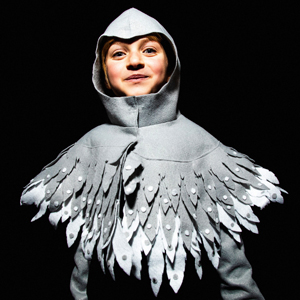
Photograph by Joe Mazza / Brave Lux
The Cuckoo: Introduction
The Cuckoo “The Cuckoo” is a lesser-known nursery rhyme with beauty and simplicity in its language and theme. In the video, Miss Natalie teaches the rhyme to Frances as she helps her slip on her wings. The transformative power of imagination is easy to see; Frances becomes a bird for the rest of the video. She teaches the other children how to fly as they play a game of “flocking,” a gentle and elegant form of follow-the-leader. We suggest teaching this rhyme in the springtime when birds are abundant and busy. All About Birds Birds are intriguing animals; of course we are fascinated by them. Light-bodied, with feathery wings and hollow bones…they fly! With their beaks and claws they hunt for insects, worms, moths, caterpillars, fish, crabs, mice, snakes, seeds, and berries. They build nests from twigs, bits of grass, leaves, and mud. They live alongside us, sometimes making their homes in tree branches or hollows, in barn rafters, and in the nooks and crannies of our houses. Ask your children if they have ever seen a bird’s nest. Maybe there is one in your schoolyard. If you find an abandoned bird’s nest, bring it in for the children to investigate. Migration Many birds migrate to warmer places for the winter months. Ask your children why birds might need to change where they live during the chilly seasons. Birds travel great distances to escape the cold in order to survive. They often make their long journey in large groups called “flocks.” If it is springtime, your children can look for the arrival of new birds and listen for the sound of birdsongs, especially at dawn and dusk. Feed the Birds Since migrating birds are on the move this time of year, it’s the perfect moment to hang a bird feeder outside your classroom window to observe the variety of birds in your zone. Migrating birds are hungry from their long journeys. If you feed the birds, you can help them recover and keep up their strength as they fly to their warm weather homes. Teach your children the names of the birds and how to recognize their calls. Make a little book or a big chart to remember the ones you have spotted. Hatchlings and Fledglings By studying the life cycle of birds, children will learn many new words. Birds lay eggs and keep their “nestlings” warm with the heat of their bodies. That period of time is called “incubation.” It ends when the baby birds grow large enough to peck their way out of their protective shells. They “hatch.” The parent birds bring food to the nest for the new “hatchlings” until they are strong enough to fly. And while they are learning to fly, we call them “fledglings.” Some birds will have more than one “brood” (group of babies) during a season. When children grow up and leave home, we call it “leaving the nest” and parents are left with an “empty nest.” Up With the Birds There are more colorful bird themed expressions to learn: “a little bird told me,” “birds of a feather flock together,” “the early bird gets the worm,” “a bird in the hand is worth two in the bush,” “a bird’s eye view,” “free as a bird,” “a night owl,” “the dawn chorus,” and “up with the birds.” Bird Names Our planet is teeming with life. There are tens of thousands of species of birds in the world, the cuckoo is just one. Learn the names of other birds with your children. Here are some examples: robin, crow, eagle, sparrow, dove, finch, duck, goose, stork, woodpecker, loon, pelican, crane, owl, ostrich, seagull, canary, blue jay, turkey, swan, hawk, goldfinch, flamingo, and so many more. When to Whisper In the music video, The Cuckoo carries “good tidings” and whispers them into Mother Goose’s ear. Children should know there are times when whispering is preferred. Speaking in a quiet voice is best when we need to be respectful (such as in a library, a museum, a theatre, a hospital, or a place of worship like a synagogue, mosque, or church). We lower our voices when a frightened animal is near. If we don’t want to wake the baby from their nap, we whisper. We use different voices for different purposes and situations. A Whispering Game You can play a whispering game with your children. While sitting in circle-time, think of a simple phrase such as “the days are getting warmer” and whisper it to the child sitting next to you. Encourage them to pass it on to the child next to them, and so on. When it returns to you, say it aloud and then tell the class your original phrase. Invariably, the message has been altered by its journey around the full circle. Children will learn that this is why rumors can’t be trusted! “The Cuckoo” and its central theme of birds will pair well with another Cabinet of Wonder poem, “Mary Had a Pretty Bird.”
The Cuckoo: Discussion
Flying South for the Winter
Did you know that some birds fly very, very far to escape the long cold winter? They “migrate” to warmer places. Some birds travel thousands of miles every year to their winter homes. Why do you think they do that?
Hatchlings
In the springtime, birds will build a little comfy, safe and warm place where they can lay their eggs. Have you ever seen a bird building a nest?
Once the eggs are laid, birds will sit on their eggs to keep them warm until they hatch. The little baby birds crack the eggs open by pecking them from the inside! When they peek their heads out of the broken egg shell, they are called “hatchlings.”
The mother and father birds take turns feeding their babies until they can fly. While they are learning to fly, we call them “fledglings.”
When you grow up and leave your home, people will say you have “left the nest” and your parents will have an “empty nest.”
Bird Talk
Do you ever listen to bird songs? Birds use different songs to talk to each other. Every type of bird has a special language of calls and songs. Do you ever imagine what the birds are saying to one another? Why don’t we go outside and listen for birdsongs together?
Naming the Birds
The Cuckoo is one type of bird; can you name any others?
Examples: robin, crow, eagle, sparrow, dove, finch, duck, goose, stork, red-headed woodpecker, loon, pelican, crane, owl, ostrich, seagull, canary, blue jay, turkey, swan, hawk, goldfinch, flamingo, and many more.
When to Whisper
In the video, The Cuckoo whispers her “good tidings” into Mother Goose’s ear (“tidings” is an old fashioned way of saying “news”). We use different voices for different purposes and situations. When do you think a whispering voice is the best voice to use?
We whisper when:
…we need to be respectful and quiet.
…we are inside a library, museum, theatre or hospital.
…we are in a place of worship like a synagogue, mosque, or church.
…we don’t want to wake up the baby.
…we don’t want to disturb someone who is concentrating.
…a frightened animal is near.
The Cuckoo: Language
KEY RHYMING WORDS
flies – lies
fly – lie
RESPONSE RHYMES
tries – skies – spies – size – wise – guys – dries – sighs – rise – buys
try – spy – my – by – dry – hi – sigh – why – pie – high
VOCABULARY
“flock”
“flocking”
“migrate”
“migration”
“nestling”
“hatchling”
“fledgling”
“good tidings”
IDIOMS
“a little bird told me”
“empty nest”
“birds of a feather flock together”
“a bird in the hand is worth two in the bush”
“a bird’s eye view”
“free as a bird”
“a night owl”
“the early bird gets the worm”
“up with the birds”
“the dawn chorus”
The Cuckoo: Activities
OVERVIEW In the following activities, your class will hang a bird feeder and become familiar with the birds in your zone, or the ones just passing through on their migratory journey. Your children will learn to play a whispering circle game. They will “flock” and practice mirroring. They will gracefully dance with scarves and use their faces, bodies, and voices to communicate character traits. Through a series of sweet and gentle games, they will practice working together as an ensemble. 1. ACTIVITY: Feed the Birds Migrating birds are on the move in April. It’s the perfect time to hang a bird feeder outside your classroom window. Migrating birds are hungry from their long journeys. You can feed them and help keep up their strength. Learn their names and try to recognize their calls. Make a little book or a big chart to remember the ones you have spotted. 2. ACTIVITY: Dancing with Scarves Materials: scarves Teacher: “Who wants to dance to this song with a beautiful silky scarf? Let’s listen to ‘The Cuckoo’ and think about how we will move. We could move like birds flying in the sky, or leaves blowing in the trees, or clouds floating past the moon.” 3. GAME: The Whispering Circle Teacher: “Who wants to play ‘The Whispering Circle’? Let’s see if we can pass a secret all the way around our circle. Remember to use your softest voice in this game.” Seated in a circle. 1. Teacher: Think of a simple phrase. 2. Whisper this phrase to the child sitting next to you. 3. Have this child repeat this phrase to the child next to them. 4. Continue passing the phrase around the circle until it returns to you. 5. Teacher: say the phrase out loud and then tell the class your original phrase. You may be very surprised by how it changed! 6. Repeat the game with a new player inventing a new phrase. 4. GAME: Flocking* Materials: a bell floor markings to represent “nests” Movement Choice Board: hopping, flapping, soaring, gliding, dipping, turning, tiptoeing, spinning, etc. Teacher: “Let’s play a game called ‘Flocking.’ A group of birds flying together is called a ‘flock.’ There is always one bird that flies in the front of the flock and all the other birds follow and imitate the leader. In this game, we take turns being the leader of our little flock.” Everyone standing in a circle, each child on a marker that represents their “nest.” 1. Choose a child to be the lead bird. 2. This child selects one movement from the Choice Board: hopping, flapping, soaring, gliding, dipping, turning, tiptoeing, spinning, etc. 3. Play “The Cuckoo” song. 4. The lead bird moves around the space in the manner of the chosen word. 5. All the other birds leave their nests to follow their lead. 6. Teacher: rings the bell when it’s time to choose a new leader. 7. The leader chooses another child to guide the flock. VARIANT 1: All the Birds Were Sleeping** Teacher: “We’re going to change the game and call it ‘All the Birds Were Sleeping.’ In this new game, all our little birds are sleeping in their nests.” NOTE: The game is played exactly the same but the children begin and end lying in their nests. VARIANT 2: And When They Woke Up… Teacher: “This time I’m going to add something to the game and say, ‘All the birds were sleeping, but when they woke up they ______________’. Then we’re going to pick a word that tells us what our little birds will do after they wake up. They might be dancing, spinning, hopping, skipping. Listen to find out what to do when you wake up.” NOTE: The game is played exactly the same as above but when the children wake from their nests they move in the manner of a word from the Movement Choice Board: danced, twirled, tiptoed, bowed, galloped, sang, jumped, leapt, hopped on one, foot, crawled, skipped, rolled, found a partner to dance with (or 2, 3, 4), etc. VARIANT 3: All The Birds Felt Happy Teacher: “Let’s try playing the game in a new way. All the birds were sleeping, but when they woke up they felt…” NOTE: Instead of waking up to do a motion, the birds wake up to an emotion instead: happy, angry, sad, silly, excited, afraid, surprised, etc. *Flocking is borrowed from Anne Bogart, Viewpoints. **Original game: “All the Children Were Sleeping.”
The Cuckoo: Music
THE MUSIC
How does this music make you feel?
Is this music slow or fast?
Does it change your mood?
What pictures does this music create in your mind?
Do you imagine a particular place, person, thing, color, animal, etc.?
How would you move to this music?
How would you move your hand in the air if you were conducting this song?
THE INSTRUMENTS
What musical instruments do you hear, can you name them?
How do you think the musical instruments make their sounds?
Are they blown through, plucked, strummed, bowed, tapped, hit, or struck?
What instrument families do these instruments belong to?
Are these instruments made of wood or metal?
Does this musical instrument play high or low pitches?
Acoustic Guitar
“The Cuckoo” has the simplest song arrangements of all the Cabinet of Wonder rhyme-songs. It features just a solo acoustic guitar and Mother Goose’s voice. You can identify the acoustic guitar and explain that although it is in the string family, it’s not an orchestral instrument. The modern acoustic guitar’s “body,” “neck,” and “bridge” and “headstock” are all made of wood, while the tuning pegs are metal. It has six strings that can be metal, nylon or other materials.
GENRE: Folk
The Cuckoo: Related Rhymes
This could make a fun game rhyme, notice how similar the cadence of the rhyme is to birdsong!
Cuckoo, Cherry Tree
Cuckoo,
Cherry tree,
Catch a bird
And give it to me.
Another Mother Goose rhyme that mentions the Cuckoo is “The Man in the Wilderness.”
The Man in the Wilderness
The man in the wilderness asked of me
How many strawberries grow in the salt sea?
And I answered him as I thought good,
As many a ship sails in the wood.
The man in the wilderness asked me why
His hen could swim and his pig could fly?
And I answered him, as I thought best,
They were both born in a cuckoo’s nest.
The man in the wilderness asked me to tell
All the sands in the sea and I counted them well.
He said with a grin, well, not one more?
I answered him, you go make sure.
The Cuckoo: Standards

Head Start Early Learning Outcomes Framework (ELOF)
Preschool Social and Emotional Development 6 | Child expresses a broad range of emotions and recognizes these emotions in self and others. |
Preschool Scientific Inquiry 2 | Child engages in scientific talk. |
Preschool Approaches to Learning 11 | Child shows interest in and curiosity about the world around them. |
Preschool Language and Literacy 2 | Child understands and responds to increasingly complex communication and language from others. |
Preschool Language and Literacy 5 | Child asks and answers questions about a book that was read aloud. |
The Head Start Early Learning Outcomes Framework: Ages Birth to Five (ELOF) presents five broad areas of early learning, referred to as central domains. The framework is designed to show the continuum of learning for infants, toddlers, and preschoolers. It is grounded in comprehensive research around what young children should know and be able to do during their early years.
The Head Start Program Performance Standards require grantees to implement program and teaching practices that are aligned with the ELOF. Education managers use the ELOF Implementation Toolkit to guide the alignment process and help their programs strengthen practices to promote children’s development in all ELOF domains.
The Cabinet of Wonder teaching guides are in alignment with Head Start’s ELOF. They have been designed to enhance any standard preschool curriculum by assisting teachers and families in both meeting school readiness goals and developing a joyful learning journey!